
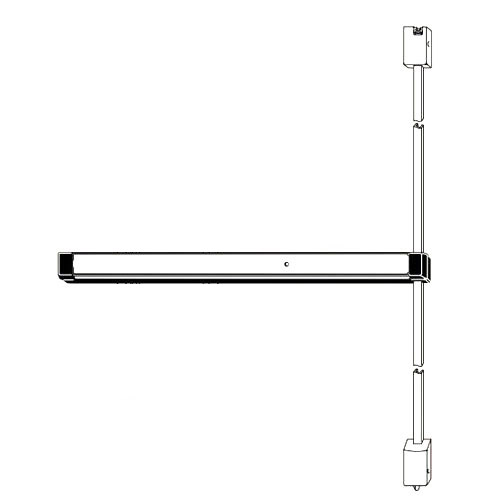
Adams Rite 8200 vs 8802: Vertical Rod or Rim Exit Device
Posted by Kent on 24th Sep 2026
Two exit devices, two different jobs on a narrow-stile door
Storefront doors need panic hardware because code says so, not because anyone asked for it. Once that's settled, the real question is which exit device the opening actually wants: something that locks the door at two points, top and bottom, or something that latches once, at the strike, and gets on with it. That's the split between the Adams Rite 8200 and the Adams Rite 8802, and it isn't a coin flip. It comes down to whether you've got one active leaf or two.
Adams Rite 8200: surface vertical rod, built for a pair
The Adams Rite 8200 is a surface vertical rod (SVR) exit device for narrow-stile aluminum and glass doors where panic hardware is required by code. An SVR pushes a rod up the face of the door into the head of the frame and another down toward the threshold, so the door locks at two points instead of one. That matters on a pair of doors where you want both leaves latched without a mullion sitting between them and blocking a wide load through the opening. Pull the mullion, run SVR on both leaves, and you've got a clear double-door opening that still locks top and bottom on each side.
It ships in a 30" door width and a handful of finishes, US32D satin stainless among them. One thing worth saying plainly: SVR hardware has more moving parts exposed on the face of the door than a rim device does, and vertical rods can develop the same alignment gripes any two-point mechanism does over years of slamming. That's not a knock on the 8200. It's the tradeoff for not needing a mullion.
Adams Rite 8802: rim exit, and now it can tell the panel something
The Adams Rite 8802 is a rim exit device in the 8800 line, also built for narrow-stile aluminum doors under the same code-required panic hardware, but latching once, into a strike mounted on the frame at the device's height. No rods, no top-of-frame prep, no bottom sweep to clear. That's the right call on a single door, or on the active leaf of a pair where the inactive leaf is already handled by flush bolts or its own SVR.
Where the 8802 earns its own line item is the monitoring switch. It comes in a single monitor (M) and a dual monitor (M2) configuration. Single monitor reports one condition back to the access panel; dual monitor reports two independently. If the integrator on the job only needs to know the bar's been pushed, M is plenty and it's the cheaper part. If the spec calls for confirming both the latch state and something else, like a request-to-exit signal running off the same device, M2 is what's built to carry it. Don't order M2 out of habit because "more monitoring is safer." Ask the integrator what the panel input is actually wired to expect, then order the one that matches. It ships in 30", 36", 42", and 48" widths, which covers most single and pair-leaf door widths you'll run into on a storefront.
So which one does your door actually need
If there's a mullion in the opening and you're not removing it, the mullion post already gives you a strike location and a rim device like the 8802 is the simpler, cheaper build. If the job wants the mullion gone for a full clear opening on a pair, you're into vertical rod territory on both leaves, and the 8200 is the Adams Rite answer for that. Single door, no mullion question to answer at all: rim device, every time. I've swapped more than one SVR back to a rim device on a single-door job because someone specified vertical rod out of habit from a pair job down the hall. It works, technically. It's also two extra strikes' worth of hardware and labor for a door that never needed them.
Finish and monitoring aren't the same decision
Finish is finish; pick what matches the rest of the storefront hardware. The monitoring switch on the 8802 is a separate decision from finish or width, and it's the one most likely to get ordered wrong because nobody circled back to the access control side of the job before the hardware order went in. If you don't know yet whether the panel needs single or dual monitoring, that's a five-minute phone call, not a guess.
For the electrified side of the same opening, our Adams Rite 7400 electric strike guide covers what happens when this door also needs access control on a preloaded frame. And if the door's exit hardware is a paddle instead of a bar, the 4591 paddle handing guide is the one to read before ordering.
Common questions
Do I need a mullion with the Adams Rite 8802?
Yes, on a pair of doors. The 8802 is a rim device, so it latches into a strike, and on a pair that strike is typically mounted on a removable mullion between the leaves. On a single door there's no mullion question, the strike mounts to the frame.
Can I remove the mullion and still use a rim exit device?
Not cleanly. Pulling the mullion on a pair takes away the 8802's strike location. That's when a surface vertical rod device like the 8200 makes sense, since it locks into the head and threshold instead of a center post.
What's the difference between the 8802's M and M2 monitoring?
M is a single monitoring switch, reporting one condition to the access panel. M2 is a dual monitoring switch, reporting two conditions independently. Match it to what the panel's input is actually configured to receive.
Does the Adams Rite 8200 come in widths other than 30 inches?
The 30" width is what's in stock here. If your opening runs wider, call before ordering so we can confirm what's available for your exact door width.
Is either device rated for a fire door?
Both are built for narrow-stile aluminum and glass doors where panic hardware is code-required, but a fire rating is a separate listing question. Confirm the specific opening's fire door requirements before specifying either device.