
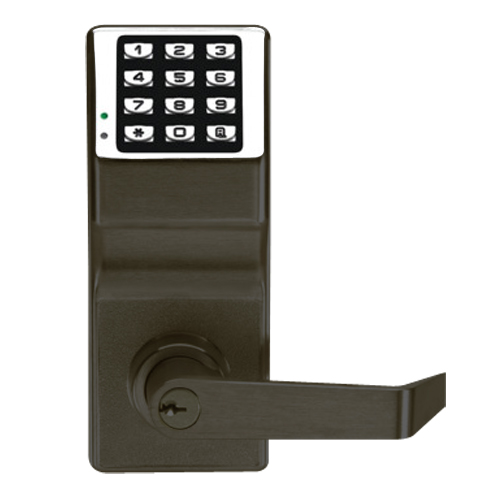
Alarm Lock DL2700, DL3200, DL4100IC: Which Trilogy PIN Lock
Posted by Kent on 22nd Oct 2026
Three Trilogy PIN locks that look alike on a quote
The Alarm Lock Trilogy DL2700, DL3200 and DL4100 all show up when you search for a standalone PIN lock for a cylindrical door prep. The catalog lists all three as a digital cylindrical keyless lock, PIN only, battery powered, with a built-in audit trail. They are close enough that a buyer sees three listings and asks which one is the "real" one. The answer is that the three differ in the key override and in the series name, not in how the keypad works.
What all three do the same
- Access: PIN only. You enter a code on the keypad and the lever unlocks.
- Power: AA batteries. No wiring, no panel, no network.
- Users: 100 to 2,000, per the catalog.
- Audit trail: up to 40,000 events held in the lock.
- Mount: cylindrical.
- Programming: at the door, with the programming code.
If you want a prox reader added, the catalog points you to the PDL versions. If you want the lock reporting to a network, that is the Networx 6000 line, and the DL6100 guide covers that step up.
DL2700: the standard
The DL2700-US10B is described as the Trilogy workhorse. The listing says it is most popular for office doors, server rooms and storage areas. It ships with a Schlage C keyway cylinder for key override, which is the detail to remember. If your building's keys are not Schlage C, that cylinder is no help to you. Our longer guide on this lock is here.
DL3200: the T3
The DL3200-US10B is listed as the Trilogy T3 series with a straight leverset. Like the DL2700, the listing says it includes a Schlage C keyway cylinder and notes that IC versions are available for other keyways. The listing does not state what a T3 does that a T2 does not, and its specification table matches the DL2700 line for line: the same PIN-only access, mount, power, user range and audit trail. On paper the T3 buys you a straight lever and a different series name.
We are not going to invent the T2 versus T3 difference. If the schedule calls for a T3 specifically, order the DL3200. If the schedule only says Trilogy PIN lock, the DL2700 does the same job.
DL4100IC: the core override
The DL4100IC-US26D is the one that matters when you run a keying system. The part number breakdown in the catalog reads DL (digital lock, PIN only), 4100 (cylindrical lock), IC (interchangeable core, standard Arrow), and the finish. It is prepped for an interchangeable core so the key override is your own existing keyway. The core and keys are ordered separately.
The product name in the catalog also says "with Best Core Override Core." The description says standard Arrow IC prep. Those two do not agree, and we do not take a side. An Arrow core and a Best core are not the same part. Before you buy cores for this lock, confirm with us which prep it has, and we will check it against the manufacturer's data.
What you are signing up for with a PIN-only lock
A PIN-only lock is a shared secret on a keypad. That is both its appeal and its limit. There is no card to lose and no key to copy, but there is also nothing stopping one person from reading a code over another person's shoulder. In an office, a back-of-house room or a supply closet, that trade is usually fine. On a door where you need to know exactly who came in, a PIN is a weaker answer than a card, and the audit trail will show the code that was used, not the person who used it. If each person has their own code, the trail means something. If three people share one code, it does not.
Battery and programming, plain terms
These run on AA batteries and are programmed at the door with the programming code, which means nobody has to pull a cable or run a conduit. The catalog does not list a battery life figure in the text we have, so do not promise one to a customer. Pick a day on the calendar, put it on the facility checklist, and change the batteries on that schedule rather than waiting for the lock to complain. A lock that dies on a Monday morning in front of a locked door is the call that costs the most.
Before you replace an old lock
- Check the existing prep against the part. Measure the cross bore and the edge bore against the lock you are removing.
- Note the finish on the neighboring hardware. The listings here are in oil rubbed bronze (US10B) and satin chrome (US26D). Other finishes exist across the line.
- Decide the key override. If the building has its own keyway, you want the interchangeable core version so the master key works.
- Decide who holds the programming code, and write it down somewhere other than the lock.
Reading the part numbers
- DL: digital lock, PIN only. PDL adds prox.
- 2700, 3200, 4100: the model family.
- IC: interchangeable core prep.
- US10B, US26D: the finish. US10B is oil rubbed bronze, US26D is satin chrome.
Which one to order
- Your keyway is Schlage C, or you do not care about the key override: DL2700.
- The schedule says T3 or DL3200: DL3200.
- You run an interchangeable core system: DL4100IC, and confirm the core type first.
Whichever you choose, the user list lives in the lock, so decide who owns the codes before you install. When a code leaves with a person, someone has to walk to the door. That is the real cost of a standalone lock, and it is the thing to weigh against a networked system. The rest of the line is on the Alarm Lock page.