
Corbin Russwin ML2053 vs ML2058 vs ML2024
Posted by Kent on 13th Oct 2026
Entrance doors that look alike
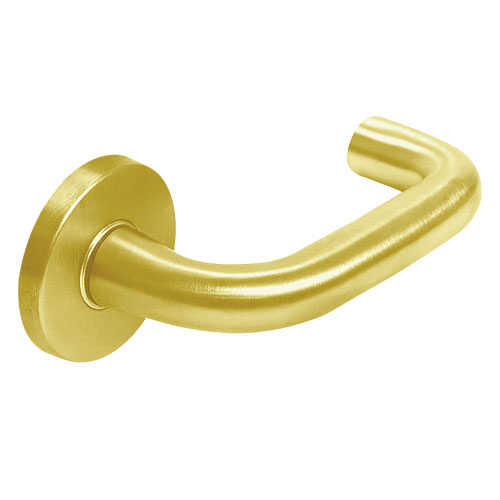
Four Corbin Russwin ML2000 functions get ordered for doors that people walk through all day: the ML2053 entrance, the ML2058 entrance holdback, the ML2024 entrance with deadbolt and the ML2068 privacy or apartment. All four are ML2000 Series Grade 1 mortise locksets with Lustra lever trim, shown in bright brass. The differences matter more than the numbers suggest.
ML2053: the workhorse entrance
ML2053-LWA-605 gives key access from outside with a turn- or button-controlled lock and free egress inside. The catalog calls it the workhorse function for entrance and office doors. Someone inside can lock the door, the key opens it from outside, and nobody is trapped. It is what most office suites and small business entries use, and it is the default when nobody has a reason to pick something else.
ML2058: entrance holdback
ML2058-LWA-605 adds the holdback feature. The catalog describes it this way: the latchbolt retracts by grip from either side unless the outside grip is locked, the outside grip locks or unlocks by key or thumbturn, and the latchbolt can be held in a retracted position by key or thumbturn and released by key or thumbturn. In plain words, you can park the latch open so the door swings freely, then release it at the end of the day.
That is the lock for a store or office entrance that stays open during business hours. Spec details from the catalog: 2-3/4 in. backset, field reversible handing, 6-pin cylinder with L4 keyway standard, two nickel silver keys, wrought lever and rose, 1-3/4 in. door thickness, and a 5-7/8 in. by 4 in. heavy-gauge steel lockcase. The line is rated ANSI/BHMA A156.13 Series 1000, Grade 1. The catalog also mentions ML2000HS high security and ML2000VR vandal resistant series for harder environments.
ML2024: entrance with deadbolt
ML2024-LWA-605 is listed as an entrance lockset with deadbolt. The catalog text repeats the same wording as the ML2053: key access from outside, free egress inside. The addition is the deadbolt. A separate bolt gives a second layer of security on an exterior or tenant door. I do not have a throw length for it on this page, so I will not quote one.
ML2068: privacy or apartment
ML2068-LWA-605 is the privacy or apartment function. A thumbturn inside throws the lock, with an emergency release that lets staff trip it from the hall. It suits bathrooms and bedrooms, not entrance doors. A common mistake is buying it for an apartment entry because of the word apartment, then finding the outside has no key. Check your door's job first.
Side by side
| Function | Key from outside | Extra feature | Use |
|---|---|---|---|
| ML2053 entrance | Yes | Turn or button lock inside | Office and general entrances |
| ML2058 holdback | Yes | Latchbolt can be held retracted | Doors open by day, locked at night |
| ML2024 with deadbolt | Yes | Separate deadbolt | Tenant and exterior doors |
| ML2068 privacy/apartment | Emergency release only | Inside thumbturn | Bathrooms, bedrooms |
Before you order
Decide four things. Does the door stay open during the day? Does it need a separate bolt? Who carries the key that parks and releases the latch? And does the keyway match the rest of the building? The standard cylinder on the ML2058 is a 6-pin L4 keyway. If your keys are a different system, order the lock to suit or plan to re-cylinder it. A lock that does not match the master key is a lock somebody carries an extra key for.
Picking by door, not by number
Start with how the door is used, because that settles the function. A suite door that is closed and locked most of the day, with employees coming and going on keys, is an ML2053. A retail or clinic entrance that stands open to the public from nine to five and locks at close is an ML2058, because the holdback lets staff park the latch instead of propping it. A tenant or exterior door where you want a second, separate bolt is an ML2024. A bedroom, a bath or a staff restroom is an ML2068.
Then think about who opens and closes the building. The holdback only helps if somebody is assigned to release it at night. Put that duty on a named person with a key, and write it on the closing checklist. I have seen entrances left parked open overnight because nobody owned the last step. The hardware did its job. The routine did not.
Finally, check the rest of the opening. A strong mortise lock in a weak frame is still a weak door. Look at the hinges, the strike and the frame anchoring before you spend money on the lock, and plan the whole opening rather than one part of it. The catalog lists the ML2058 strike as an ANSI straight lip, 4-7/8 in. by 1-1/4 in. by 1-1/8 in. lip to center. Make sure your frame is prepped to match.
Mistakes I see
- Using the ML2053 on a door that stays open for customers. Staff prop it with a wedge. The holdback fixes that.
- Forgetting to decide who holds the holdback key. It holds with a key or thumbturn, so name the person.
- Buying the ML2068 for an entry. It is a privacy lock.
- Mismatched keyways. Match the cylinder to the building.
Common questions
What does the ML2058 holdback do?
It lets staff hold the latchbolt retracted with a key or thumbturn so the door swings freely, then release it later.
What is the backset?
2-3/4 in. on the ML2058 per the catalog, with field reversible handing.
Is the ML2024 different from the ML2053?
It adds a deadbolt. The outside key and inside egress behavior are described the same way.
Can the ML2068 be used on an entrance?
No. It is a privacy function with an emergency release.
For storeroom and deadbolt details read our ML2057 versus ML2059 guide, and the ML2010 versus ML2050 article. See the Corbin Russwin page or tell us the opening.