
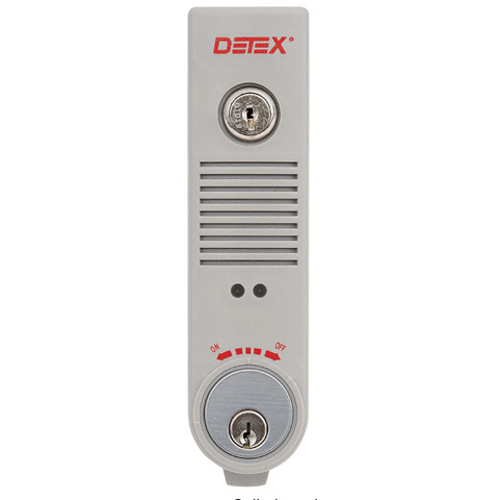
Detex EAX-500 vs EAX-500W Weatherized Door Alarm
Posted by Kent on 9th Oct 2026
An exit door outside the building needs a different alarm
A battery door alarm is a simple thing on an interior door. It gets harder when the door opens to the weather: a loading dock, a back stairwell, a fenced yard, a pool deck. Rain, sprinklers, frost and salt air all get at the electronics. The Detex EAX-500 comes in a standard version and a weatherized EAX-500W, and the choice between them is mostly about where the door faces. Finish is the second choice, because both come in gray and black.
What the two share
Per the catalog, the EAX-500 family is a battery-powered, surface-mount exit alarm. It needs no wiring, and the listing says it installs in under 30 minutes. The specs it gives:
- Power: one 9V battery, included.
- Sound: 95 dB piezo horn.
- Mounting: surface mount on the door frame.
- Doors: single doors, in-swing or out-swing.
- Housing: die-cast.
- Reset: by key, standard or IC7.
- Listings and codes: UL Listed, meets NFPA 101 Life Safety Code, ADA compliant, and does not restrict emergency egress.
In the box: the alarm unit, mounting hardware, the 9V battery, two keys and the installation instructions. The door switch kit is a separate decision, covered below.
The difference: sealed housing
The W models are described as weatherized for outdoor and exterior use, with a sealed housing and protected electronics. That is the only change the listing calls out. The sound level, power, mounting and reset are the same as the standard unit.
So the rule is short. If the alarm will sit inside the building, on a door that never sees rain, buy the standard unit. If it will sit outside, or in a spot that gets wet or washed down, buy the W. A standard unit on an exterior wall is a service call waiting for its first storm.
The four models
- EAX-500: standard, gray.
- EAX-500 BK: standard, black.
- EAX-500W: weatherized, gray.
- EAX-500W BK: weatherized, black.
On gray or black, match what is already on the door. An alarm is a visible piece of hardware, and it is meant to be. It tells a person walking up that the door is monitored. Black reads cleaner against a dark bronze storefront or a black steel frame. Gray suits painted hollow metal. Pick whichever looks like it belongs, because an alarm that looks like an afterthought gets treated like one.
Pick the switch kit before you order
The alarm does nothing until it knows when the door opens. The listing points to a family of switch kits, and the right one depends on the frame:
- SK1: standard surface mount, for most hollow metal and wood frames.
- SK2: wide-gap aluminum storefront frames.
- SK3: concealed installation in wood.
- SK4: armor-plated, for high-abuse areas.
- SK5: uneven gaps.
- SK6: overhead mounting.
The listing says that when in doubt you should measure the door-to-frame gap. Do it with the door shut. An outdoor door often has a weatherstrip or a sweep that changes the gap you assumed, and a swollen wood frame in August is not the frame you measured in January. Call us with the number if the kit choice is not obvious.
Standard key or IC7
The listing describes two reset options. The standard key is a fixed key unique to the EAX-500. The IC7 accepts Detex interchangeable cores, so you can rekey without taking the lock off the device. If you manage more than one alarmed door, IC7 is the smart choice, because one core change replaces a drawer full of keys. For a single back door with one manager, the standard key is fine.
A key switch for the staff desk
The catalog says a key switch, the KS option, can be added as a remote on and off switch. Mount it at a staff desk or behind a counter so employees can silence the alarm without walking to the door. The listing says to order the EAX-500KS variant or add a key switch kit separately. This helps in a shop where deliveries come through the back door a dozen times a day and nobody wants to run across the building with a key.
If you would rather the alarm re-arm itself after a delivery, the Detex EAX-3500 has a timed bypass. Our EAX-2500 vs EAX-3500 article covers it.
What an alarm does and does not do
This alarm makes noise when the door opens. It does not lock the door, hold it shut or call anyone. At 95 dB it is loud nearby, but a door at the far end of a warehouse needs somebody within earshot who knows what to do. Tell staff who responds and who has the key. A battery alarm is a deterrent and a prompt, not a guard.
It also needs a battery that is alive. Put a date on the calendar to swap the 9V, and test the alarm each time you do.
Before you order
- Inside or outside. Outside means the W.
- Finish. Gray or black, to match the door and frame.
- Switch kit. Measure the door-to-frame gap and check the frame type against SK1 through SK6.
- Reset key. Standard or IC7.
- Remote silence. Add the KS if staff need to turn it off from a desk.
Common questions
How loud is the EAX-500?
The listing gives 95 dB from a piezo horn.
What battery does it use?
One 9V battery, included.
Is the weatherized version louder or different inside?
The listing calls out only the sealed housing and protected electronics. The other specs match the standard unit.
Does it work on out-swing doors?
Yes. The listing says single doors, in-swing and out-swing.
Does it need wiring?
No. It is battery powered.
The full line is on our Detex page. For a side by side with the older model, read our EAX-500 vs EAX-300 article. Send us the door type, the frame and whether it faces the weather, and we will match the model and the switch kit.