
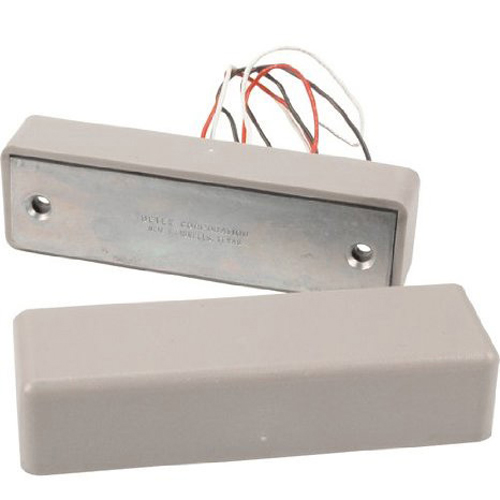
Detex MS-1039S, MS-2049S, 2049F, 2049SI: Which Contact
Posted by Kent on 6th Oct 2026
An exit alarm is only as good as the contact telling it the door moved
Most callbacks on a Detex exit alarm are not the alarm. The horn is fine. The panel is fine. The little magnetic contact on the door and frame has been knocked loose, was never lined up right, or was the wrong type for that opening. On a door that gets propped, slammed, or shoulder-checked all day, that contact takes the abuse.
Detex sells four contacts that work with its EAX-series alarms, and the part numbers read like noise until you know the code. The letters at the end are the mounting. The two digits before them, 1039 or 2049, are the construction. Learn that and the choice takes about a minute.
Reading the part number
- MS-1039 is a balanced magnetic switch. The catalog says it resists defeat by an external magnet, which matters where someone might try to hold a magnet to the frame and walk out quietly.
- MS-2049 is the heavy duty magnetic contact, listed for high-traffic or abuse-prone doors.
- S is surface mount. F is flush mount, concealed in the frame. SI is the standard mount made for in-swinging doors.
All four are listed for use with Detex EAX-series alarm hardware. Our catalog says to match the part number exactly if you are replacing an existing Detex contact. If you are swapping in a contact from another maker, check the wiring before you order.
The four contacts side by side
| Part | Type | Mount | Price |
|---|---|---|---|
| MS-1039S | Balanced magnetic switch | Surface | $82.29 |
| MS-2049S | Heavy duty contact | Surface | $240.86 |
| MS-2049F | Heavy duty contact | Flush, in the frame | $193.71 |
| MS-2049SI | Heavy duty contact | Standard mount, in-swinging door | $199.71 |
Prices are what the listings show today. Check the page before you order.
Pick by what the door goes through
A back door that gets propped or kicked: the 2049 family
If the opening is a loading door, a kitchen exit, a school corridor, or anything staff push through with a cart, start with the heavy duty 2049 series. That is what Detex lists it for. Between the three mountings, let the frame decide.
On an out-swinging door where nothing is hidden and speed matters, the MS-2049S surface mount is the easy install. You see it, a maintenance person can find it, and it is the one to replace when something goes wrong. It is also the most expensive of the four, so it is not a reason to buy surface mount over flush.
A visible contact keeps getting hit or tampered with: the flush mount
The MS-2049F sits inside the frame. Our catalog describes flush mount as concealed, for a cleaner appearance and tamper resistance. If the surface contact on that door has been pried off or painted over twice, a flush contact is the fix. The cost is the install: someone has to prepare the frame. Plan for that before the door is a customer-facing problem.
An in-swinging door: the SI
The MS-2049SI is the standard mount listed for in-swinging doors. Do not grab a surface contact for an in-swing door and hope. The geometry is different, and the catalog lists a part for this case, so use it.
A door where someone could hold a magnet to the frame: the balanced switch
The MS-1039S is the only balanced switch of the four, and the least expensive. A plain contact opens when the magnet moves away. A balanced switch is built so an outside magnet cannot simply stand in for the real one. Use it where defeating the alarm is the actual threat: a stockroom door, a pharmacy exit, a door behind a cash office. It is surface mount, so it is also the easiest to see and service.
It is not the heavy duty part. If the door takes constant abuse and the threat is also magnets, you are choosing between two catalog strengths, and we would want to hear about the opening before saying which wins. Call us with the door and the problem.
Which one do I buy first?
A short rule that holds up on most calls:
- In-swinging door: MS-2049SI.
- Out-swinging, abused, and the contact needs to be hidden: MS-2049F.
- Out-swinging, abused, and visible is fine: MS-2049S.
- Someone might defeat the alarm with a magnet: MS-1039S.
The mounting question is a frame question, and the heavy duty question is a traffic question. Answer them separately and the part number picks itself.
Where the contact fits in the alarm
The contact tells the alarm the door position. The alarm itself is a separate choice. If you are still deciding between exit alarms, we compared the EAX-500 and EAX-300, and the EAX-2500 and EAX-3500 for doors that need a prop alarm or a timed bypass.
If you run several alarmed exits, a front desk can watch them from one place. The Detex EAX-411SK door status indicator monitors up to 8 Detex alarm units from one wall-mounted panel, with LED status per zone. The catalog lists it as compatible with the EAX-300, EAX-500, EAX-2500 and EAX-3500 alarms. That is useful for finding out which contact on which door is the one that keeps failing.
Installation notes from the catalog
- Match the part number exactly when replacing an existing Detex contact.
- Verify wiring compatibility before using another maker's contact with an EAX alarm.
- Product photos on the listings are representative. Check the specifications on the page before you order.
We do not publish gap distances or wire runs for the contacts here, because the listings do not give them. The installation sheet that comes with the part does. Read it before you drill.
Not sure which opening you have?
Send us the door swing, the frame type, and what is going wrong with the current contact. We will match the part. The full line of Detex alarm hardware is on the manufacturer page, and the contacts above are in stock and ready to order.