
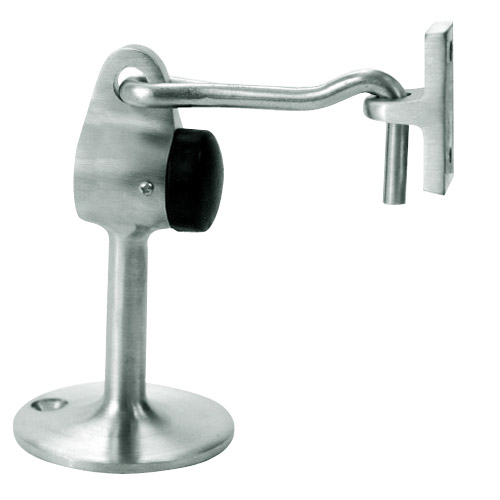
Don-Jo Door Stops: The Height That Actually Stops a Doorknob
Posted by Kent on 15th Sep 2026
Why the wrong-height door stop cracks drywall, not the stop
A door stop that is too short does not fail quietly. The rubber tip sits below the doorknob, the knob sails past it, and the knob punches a hole in the wall six months later, right through the drywall or the plaster, right where nobody wants a hole. Facilities crews replace the stop, mount it in the same spot, and get the same hole again, because the problem was never the stop. It was the height.
Don-Jo's wall-mount bumper line runs from 1-5/16" up to 3-7/8" in projection height, and the height is the whole spec that matters. Pick it off the baseboard, not off the model number you used last time.
Match the stop height to the baseboard, not to habit
A wall bumper mounts to the wall and has to project far enough out from the surface to catch the doorknob before the knob reaches drywall. If your baseboard runs 3" or 4" tall, a short 1430 stop at 1-5/16" height sits inside that baseboard's shadow line and the knob clears right over the top of it. That is the single most common door-stop callback: someone grabbed whatever stop was in the truck, it looked fine on the shelf, and it does nothing once it is on the wall.
The fix is boring and it works: measure the doorknob's height off the finished floor, then pick a Don-Jo stop whose projection puts the bumper face in the knob's swing path, clearing the baseboard in front of it. Don-Jo publishes six common heights in this line, and matching one to your trim is a five-minute job:
- 1430: 1-5/16" height, for low-profile base trim or shoe molding
- 1449: 2-1/2" height, common residential baseboard
- 1452: 2-3/4" height, mid-range base trim
- 1471: 3-1/8" height, taller commercial base trim
- 1477: 3-1/2" height, tall base or where the knob sits high
- 1473: 3-7/8" height, the tallest in the line, for oversized base or a lever set mounted higher than standard
All six mount the same way and take the same fasteners, so switching from a 1449 to a 1477 on a callback is not a new install. It is a five-minute swap once you know which height you actually need.
How the Don-Jo 1473 is built
The 1473 is a cast brass wall bumper with a 2-1/4" base and concealed-type mounting, meaning the mounting screws sit behind the bumper body, not exposed on the wall, so the finished look is clean and there is nothing for a passerby to catch a coat sleeve on. It ships with a full fastener set: a machine-screw stud and a sheet-metal-screw stud, plus plastic anchors and lead expansion shields, so it goes into drywall, plaster, or masonry without a separate trip for anchors. It carries ANSI A156.16, Type L11371 compliance, and Don-Jo backs it with a one-year limited warranty.
The shorter 1471 and 1477 use the same body architecture at their own heights, and the same is true down the line to the 1430. Pick the height; the mounting hardware and the finish options travel with it.
Finish selection
Don-Jo stocks this line in satin chrome (626), bright brass (605), and oil-rubbed bronze (613) across most heights, with satin nickel and clear satin nickel available on a few models. Match the finish to the lever set or the door closer already on the opening — a satin chrome 626 stop next to a satin brass lever reads as mismatched the second someone looks down. If you are stocking a truck for mixed service calls, 626 and 605 cover the two most common finish requests on commercial and residential doors respectively.
When a wall bumper is the wrong call entirely
A wall stop only works if there is wall behind the door's open swing to mount it on. If the door swings into an open hallway, past a corner, or against a window, there is nothing to screw a wall bumper into, and a floor-mounted stop or an overhead stop (see our Glynn-Johnson 450 overhead stop guide) is the right hardware instead. If the doorknob has already put a hole in the wall, a wall bumper prevents the next one. It does not patch the one that is already there.
Common questions
How do I measure for the right door stop height before I order?
Measure from the finished floor to the center of the doorknob, then measure the baseboard height at the mounting point. The stop's height rating needs to put the bumper face at or above the knob's centerline while still clearing the top edge of the baseboard. If the knob sits at 38" and the baseboard is 4" tall, a stop under 4" tall will sit behind the baseboard's shadow and miss the knob.
Can I use a taller door stop than I need?
Yes, within reason. A stop that projects higher than strictly necessary still catches the knob, so you are only in trouble if it is too short, not too tall. The tradeoff is cosmetic: an oversized stop above a short baseboard can look out of proportion, so match height to trim when it is a visible install, like a lobby or office front.
Do all Don-Jo wall stops use the same screws?
Within this line, yes. Each ships with a machine-screw stud, a sheet-metal-screw stud, plastic anchors, and lead expansion shields, so the same stop mounts into drywall, wood, or masonry without a separate hardware trip.
What is concealed-type mounting?
It means the fastener sits behind the bumper body once assembled, so no screw head is visible on the finished wall. It is a cosmetic feature, not a security feature. Do not confuse it with a security-rated or tamper-resistant fastener.
Is a wall bumper enough to stop a door from denting a wall in a high-traffic hallway?
For a door opened by hand at normal speed, yes. For a door that gets kicked open, propped with force, or hit by cart traffic repeatedly, a wall bumper alone will eventually pull out of light drywall. Back it with a stud-mounted anchor or step up to a floor stop rated for higher impact.
Lock Depot stocks the full Don-Jo wall-stop height range in the common commercial finishes. Browse the Don-Jo hardware hub for the complete line, or call 877-365-5625 if you would rather read a baseboard height over the phone than guess at a model number.
Related reading: Don-Jo Latch Protector: Stop a Pry Attack on an Outswing Door, the same manufacturer's line for a completely different failure mode: a forced latch instead of a wandering knob.