
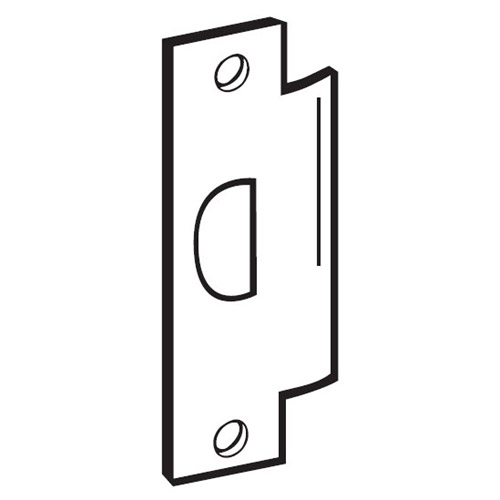
Don Jo ST-214 vs ST-261 vs ST-386: Which Strike Plate
Posted by Kent on 9th Oct 2026
A strike plate is a two dollar part that stops a door
When a door will not latch, the latch gets the blame. Half the time it is the strike: bent, worn, painted over, or the wrong size to begin with. Don Jo makes three strikes we sell a lot of, and they look similar in a catalog photo. They are not interchangeable. The ST-214, the ST-261 and the ST-386 are three different jobs, and picking by price alone gets you a plate that does not fit the cutout.
The three, by size
Start with the numbers off the listings, because the size is what decides it.
- ST-214 replacement strike: 2-1/4 in. by 1-1/4 in., 18 gauge (.050), two #8-32 by 3/4 in. flat head combination screws.
- ST-261 standard strike: 4-7/8 in. by 1-1/4 in., 13 gauge (.095) steel, two 12-24 by 3/4 in. flat head combination screws.
- ST-386 ANSI strike conversion plate: 8 in. by 1-1/4 in., aluminum, two #12-24 by 1/2 in. flat head machine screws. Reversible.
Measure the strike you have before you look at anything else. Measure the long dimension of the plate, not the cutout, and measure the cutout behind it. If the old plate is a short one, around 2-1/4 in., that is the ST-214 territory. If it is the long one that most commercial cylindrical and mortise locks use, it is the ST-261 size. The 4-7/8 in. by 1-1/4 in. dimension is the standard ANSI strike prep you will see quoted on commercial strikes, including the electric strikes we carry. If you are mixing an electric strike and a plain one on a job, those two share a faceplate size.
ST-214: the small replacement
The ST-214-630 in satin stainless and the ST-214-605 in bright brass are the replacement strikes. The listing calls the 18 gauge plate a replacement strike and does not claim a lock family, so do not take it as a match for any particular brand without checking the cutout. Where we see it used is simple: a worn or missing strike on an existing door, where the old plate was the small kind, and the owner wants something that looks right and costs next to nothing.
Finish matters more on a strike than people think. Brass against a stainless door hardware set looks like a mistake. Look at the lever or knob and match: 605 for bright brass, 630 for satin stainless. Both are in stock in the catalog and both are cheap. Stock a handful of each.
ST-261: the standard strike
The ST-261-SL and the ST-261-DU are the standard 4-7/8 in. strike. The steel is a heavier 13 gauge, almost twice the thickness of the ST-214, and that is the point. A latch bolt that hits a thin plate wears it fast. A thicker plate stands up longer on a door that slams, and a school door slams.
The finishes in the listings are silver coated (SL), duranodic (DU) and brass plated (BP). The DU text in the listing calls the finish duro coated, so if the color matters, send us the door's hardware finish and we will match it. Silver suits a door with aluminum or chrome-look hardware. Duranodic, a dark bronze look, suits aluminum storefronts and dark frames.
The listing says it is a standard strike, which means it is meant to take a standard latch. If you want to harden the door frame behind the strike, the plate is not the answer. A reinforcement is, and we cover that in our Don Jo DCB 340 and 350 strike reinforcement article. The plate is the part the latch hits. The reinforcement is what keeps the frame from splitting when somebody kicks the door.
ST-386: not a plain strike at all
The ST-386-PC is the odd one, and the name tells you why: it is an ANSI strike conversion plate. At 8 in. by 1-1/4 in., it is long. The listing says to use it with a pair of 86 cut out doors, and to apply the ANSI strike over it. In plain words, you have a pair of doors with an older, larger strike cutout, and you want to run a modern ANSI strike without cutting new metal. The conversion plate covers the old cutout, and the standard strike goes on top.
It is aluminum in a prime coated finish, so plan to paint it to match the frame. The listing says it is reversible. We do not have the detail on how the cutout in the plate is laid out beyond what the listing states, so hold the plate up to the frame and compare before you order several. If you have a pair of doors and an old cutout you cannot identify, send us a photo of the frame with a tape measure in it.
How to pick, in order
- Measure the old plate, long side and width. 2-1/4 in. points to the ST-214. 4-7/8 in. points to the ST-261.
- Is the cutout wrong? If the frame has an old oversized cutout on a pair of doors, the ST-386 is the fix, with a standard strike on top.
- Match the finish to the hardware on the door.
- Check the screw size. The ST-214 takes #8-32. The ST-261 takes 12-24. Do not reuse the old screws and hope.
- Think about abuse. A busy door wants the 13 gauge plate and a reinforcement behind it.
When a strike is not the problem
If a new strike does not cure the latching trouble, look at the door. A sagging door drops the latch below the strike, and no plate fixes that. The cure is a hinge adjustment or a new set of hinges. A latch that is too long or too short for the strike also fails. And if the lock is being swapped for a different one, the new latch face may not match the old strike at all. That is a wrap-around plate or a lock swap issue, and we cover it in our Don Jo wrap-around plate article.
Common questions
What gauge is the ST-261?
The listing gives 13 gauge (.095) steel.
What gauge is the ST-214?
18 gauge (.050).
Does the ST-386 replace the strike?
No. The listing says to apply the ANSI strike over it. It is a conversion plate, not the strike itself.
What screws come with them?
Two screws each, in the sizes listed: #8-32 by 3/4 in. for the ST-214, 12-24 by 3/4 in. for the ST-261, and #12-24 by 1/2 in. for the ST-386.
What is the warranty?
The listings state a one year limited manufacturer's warranty.
The full range of door accessories is on our Don Jo page. Tell us what you have on the door now and we will tell you which plate it takes.