
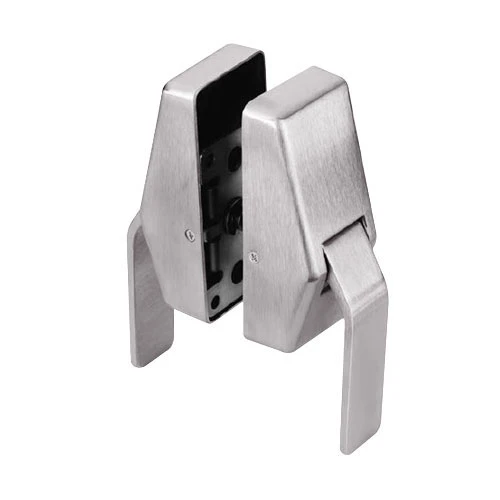
Schlage HL6: A Push-Pull Latch for a Hospital Corridor
Posted by Kent on 9th Sep 2026
What a push pull latch actually does on a hospital corridor door
A nurse comes down the corridor with a med cart. Both hands are on the push bar of that cart. The door ahead has a lever on it. Watch what happens next. She turns sideways, hooks the lever with her elbow or her hip, shoves the cart into the door edge, and keeps moving. Do that four hundred times a day across three shifts and the lever spindle starts to wallow out. Then the return spring gives up. Then the lever droops, and now it does not retract the latch at all, and you get a call at seven in the morning about a door nobody can open.
That is the whole reason the Schlage HL6 exists. It is a paddle. A wide flat plate on both faces of the door that retracts a latch when you push it with a forearm, a hip, the corner of a cart, or the heel of your hand. No grasping. No twisting. No wrist rotation. Which happens to be the exact language ADA 404.2.7 uses for operable parts, ADA 404.2.7,, so the accessibility box gets checked by the same piece of hardware that solves your cart problem.
The infection control side matters too, though I would not oversell it. Housekeeping wipes a flat plate in one pass instead of chasing the underside of a lever return where the gunk actually lives. Start at the Schlage line to see the family laid out.
Standard function versus the 9010, and this is where people get it wrong
The HL6-2-630 is the standard function unit. It is self contained. The latch mechanism lives inside the push pull assembly itself, so you are boring a door for the HL6 and nothing else. Push either side, latch retracts, door swings, latch catches the strike. It holds the door closed against a closer and against corridor air pressure. It does not lock. It never locks. There is no cylinder, no key, no thumbturn, and no way to add one later.
Now the HL6-9010-630, which is a different animal. The 9010 is a passage function trim that mounts to a mortise lock body in the door. The paddle retracts the mortise latch. And that is the point people miss. You are buying it because a real mortise lock case is going in that door, either now or on the next security review. The 9010 gives you a mortise prep, a mortise strike, a deadlatch, and a case a locksmith can service or change function on without touching the door.
When do you actually need it? When the door has to be secured after hours. When it is rated and your inspector wants a listed mortise case with the paddle as approved trim. When it leads out of the unit rather than within it. When the opening already has a mortise pocket cut into it and you are replacing failed hardware, because filling that pocket to install a self contained HL6 is a door replacement in disguise. I watched a contractor try to shim that pocket with plywood and a filler plate on a 90 minute rated leaf. The inspector took one look and failed the whole corridor.
PL7 and PL8, and getting the side right the first time
Two privacy variants. The PL7-2-630 puts the thumbturn on the push side. The PL8-2-630 puts it on the pull side. That is the difference. That is it.
Sounds trivial. It is not. Stand in the corridor and look at the restroom door. If it swings away from you into the room, the corridor is the push side, and a corridor side thumbturn means anyone walking by can lock a restroom nobody is in. You want PL8 there, thumbturn inside on the pull side, where the occupant is. Now flip it. An outswing restroom door, which is what a lot of accessibility and behavioral health layouts use so a collapsed occupant does not block the leaf. The occupant is on the push side. Thumbturn goes there. That is PL7.
My habit is to walk the door before writing the order and physically put my hand where the occupant will stand. Push or pull. Write it on the door with a grease pencil. I have seen a twelve door restroom package come in completely backwards because somebody read push side off the floor plan from the corridor's point of view. Twelve doors, restock fees, and three weeks of occupied restrooms nobody could lock.
SOC screws, lead lining, and why 630 is the only finish worth ordering
The HL6-2-630-SOC swaps the standard fasteners for pin in socket security screws. A pin in the center of the socket means a normal hex key will not seat. You need the matching driver. On a behavioral health unit or any public side corridor where someone has time and motive, that is the difference between hardware staying on the door and hardware becoming a two pound stainless object in somebody's hand. Order the drivers with the hardware and put them in the shop, not in a truck. Trucks lose things.
Lead lining is the other option worth knowing. The HL6-2-630-L exists for one reason, and it exists for one reason. A radiology suite door is a lead lined leaf. Every hole you bore through it is a hole in the shielding, and the hardware pocket is the biggest hole in the door. The physicist doing the shielding survey will find it. The lead lined version puts the shielding back inside the hardware pocket so the door passes. Skip it on a rad door and you are pulling the hardware back out after the survey.
630 is satin stainless, and on a hospital door it is the only finish I will spec. Quats, bleach wipes, hydrogen peroxide foggers, whatever the infection control committee switched to last quarter. Brass and bronze finishes cloud and pit under that. Painted and plated finishes chalk at the wear point in a year. Satin stainless takes on a patina and keeps going, and a scuff buffs out with a maroon pad.
One more thing on install. Check your closer. A push pull paddle on a door with a closer cranked to maximum will get body checked by carts all day, so verify the latch is fully engaging the strike and not just kissing it. Then go read what an overhead stop does for a door that slams into the wall, because cart corridors need one. For the patient room side of the same building, the anti ligature mortise conversation is a different set of rules entirely.
Common questions
Does the HL6 meet ADA requirements for operable parts?
Yes. ADA 404.2.7 requires hardware that operates without tight grasping, pinching, or twisting of the wrist, and a paddle you press with a forearm or hip satisfies that directly. There is no lever geometry or return spring to argue about. Verify your opening force against your local requirement, which is a function of the closer more than the latch.
Can I add a lock to a standard HL6 later?
No, and this is the most common ordering mistake on these. The standard function HL6-2-630 is self contained with no provision for a cylinder or thumbturn. If there is any chance the opening needs to secure, spec the HL6-9010-630 with the mortise lock body from the start, because retrofitting means a new door prep or a new door.
How do I know whether I need PL7 or PL8?
Stand where the occupant will be standing and see whether the door pushes away from you or pulls toward you. Occupant on the push side means PL7. Occupant on the pull side means PL8. For a normal inswing restroom off a corridor the occupant is on the pull side, so PL8. Outswing restrooms flip it.
Will a push pull latch hold a rated corridor door closed?
Only if the specific assembly is listed for that opening, which usually means the mortise lock version with a listed case and a matching strike. Rated doors need positive latching, and the listing covers the whole assembly rather than the trim alone. Bring your door schedule and rating to us and we will confirm the function against the label.
Are the SOC security screws worth it on a general corridor?
On a staff only corridor, usually not. On a behavioral health unit, a detention adjacent area, an emergency department waiting corridor, or any door the public reaches unsupervised, yes, and I would not run standard fasteners there. Keep a driver in the shop and label it, because a security screw you cannot remove is your problem too.