
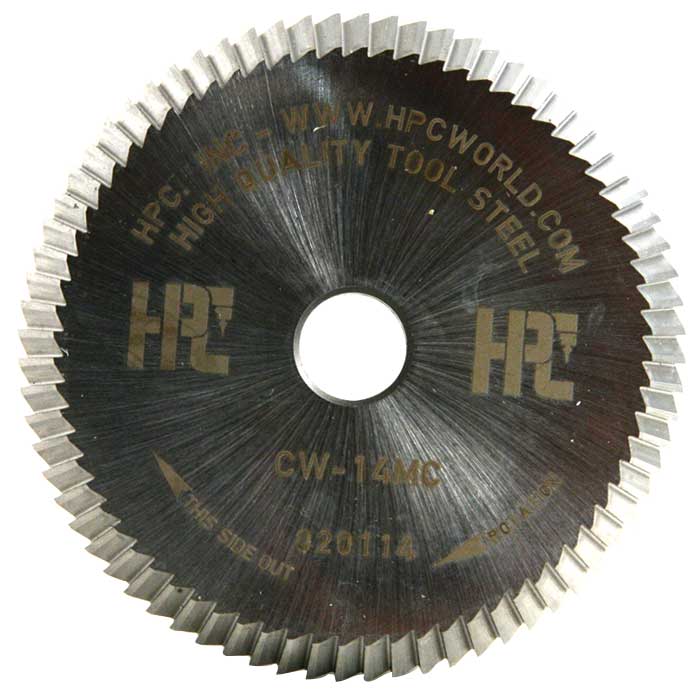
HPC Cutter Wheels CW-14MC, 1011, 1012, 20FM
Posted by Kent on 11th Oct 2026
The cutter decides the key
When a duplicated key binds or will not turn, the first suspect is the cutter, not the machine. The cutter sets the cut angle, the flat at the bottom of each cut, and whether the edge comes off clean or burred. A dull one or the wrong profile gives you a key that looks right and fails in the lock.
HPC sells cutter wheels by key system. This covers four of them: the CW-14MC, CW-1011, CW-1012 and CW-20FM. Pick by the key in your hand.
The four, side by side
| Cutter | Profile | For |
|---|---|---|
| CW-14MC | 100 degree angle | Standard large cylinder keys |
| CW-1011 | 90 degree angle | Small cylinder keys |
| CW-1012 | Milling cutter | Medeco high security keys |
| CW-20FM | 76 degree double angle, flat mill tooth | Sargent and Welch large pin keys |
CW-14MC: the everyday large cylinder cutter
The CW-14MC is HPC's 100 degree angle cutter for standard large cylinder keys. If you cut ordinary large cylinder keys all day, this is the cutter that sees the most work, so keep a spare. The angle is part of the key system, which is why the small cylinder cutter below is a separate part and not a substitute.
CW-1011: the small cylinder cutter
The CW-1011 is the 90 degree angle cutter for small cylinder keys. Small cylinder keys call for their own cutter angle. A cutter built for a different key system gives you the wrong cut shape, and that is how you end up with a key that enters the lock and refuses to turn. Do not stretch a 14MC to cover a small cylinder job.
CW-1012: Medeco high security
The CW-1012 is a milling cutter for Medeco high security keys. The listing calls it the optional milling cutter with the angle and pin seat needed to cut Medeco keys. Medeco keys carry angled cuts as well as depth, which is why a regular angle cutter will not do. This is not a cutter you buy on speculation. If you do not cut Medeco, you do not need it. If you do, a standard cutter will give you a key that only looks like one.
If your Medeco work involves drilling rather than cutting, HPC also lists the CE-500M2 carbide drill tip for KeyMark cylinders. Ask us if you need it.
CW-20FM: Sargent and Welch large pin
The CW-20FM is a 76 degree, double angle, flat mill tooth cutter made for Sargent and Welch large pin locks. A double angle cut is a different shape from the single angle wheels above. If a large pin Sargent or Welch key walks in, this is the cutter that matches it, and none of the others will.
What the listings do not say
The listings describe each cutter by profile and key system. They do not give an arbor size, diameter or the machines each cutter fits, and I will not guess. Before you order, confirm the cutter fits your machine. The listings say to match the cutter to the key system and to your machine, and that is correct. If you are not sure, send us the machine model. For the machines themselves, see our HPC Speedex comparison.
When to change a cutter
The listings give the rule: swap it when cuts start coming out rough. Here is what that looks like at the bench.
- Burrs that will not brush off. The cutter is dull. Brushing a burr you should not have is wasted time.
- Keys that go in but bind. Check the cutter angle against the key, then the cutter edge.
- A new key that wears the lock. A rough cut chews the pins. That damage lands on the customer's lock, not on your bench.
- Chatter noise on the cut. Stop. A chipped tooth ruins keys quietly.
One more habit: clean the chips out of the machine before you swap. A chip trapped behind a new cutter throws it off and you will blame the cutter.
A starter set for a van
If you are building a mobile setup, start with the large cylinder cutter and the small cylinder cutter. Those two cover most of what walks in. Add the Sargent cutter if you work institutional buildings. Add the Medeco cutter only when you have Medeco work on the books.
Keep a log of what is on the machine
A small habit that saves a lot of grief. When you swap a cutter, note the date and which cutter is on the machine. A shop with two or three people and one machine will lose track of what is mounted, and someone will cut a small cylinder key on a large cylinder cutter without noticing until the customer is back at the counter. A strip of tape on the machine with the cutter number works. So does a line in a notebook.
Matching the cutter to the job
Read the key before you pick the cutter. The key blank tells you the system, and the system tells you the cutter. Do this in order:
- Identify the key system from the blank, the stamp on the bow, or the lock it came from.
- Find the cutter built for that system in the list above.
- Check that the cutter on the machine now is the one you need. If not, swap it.
- Cut a test key on a spare blank and try it in a known good lock before you cut the customer's key.
The test cut costs a blank. A bad key costs a customer.
Common questions
Which cutter is for small cylinder keys?
The CW-1011, a 90 degree angle cutter.
Which cutter handles Medeco high security keys?
The CW-1012, a milling cutter.
What is the CW-20FM for?
Sargent and Welch large pin keys. It is a 76 degree, double angle, flat mill tooth cutter.
Will these fit my key machine?
The listings do not list machine fitment. Send us your machine model and we will confirm.
How do I know the cutter is worn?
Rough cuts. Burrs, binding keys and chatter are the signs.
See the full line on our HPC page. Tell us the key system and the machine and we will pick the cutter.