
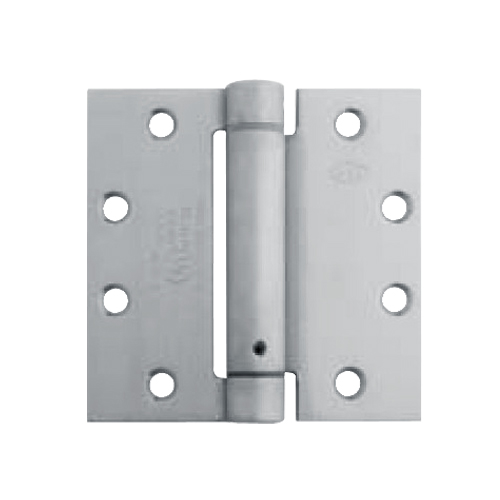
Ives 3SP1 Spring Hinge: Self-Closing Without a Closer
Posted by Kent on 15th Nov 2026
A hinge that pulls the door shut
Every locksmith has been called to a door that will not stay closed, or one that will not stay open. Sometimes the answer is a closer. On a light interior door, sometimes it is smaller than that: swap the hinges. The Ives 3SP1 is a spring hinge. The catalog describes it as a 3-knuckle full mortise butt hinge whose spring action returns the door toward closed on its own, for a self-closing leaf without a separate closer.
That is a narrow job and a useful one. This is what the listing supports, and what it leaves out.
The three sizes
Sizes are height first, then open width.
| Size | Primed example | Satin chrome example |
|---|---|---|
| 4 x 4 | 3SP1-4x4-600 | 3SP1-4x4-652 |
| 4-1/2 x 4 | 3SP1-4-5x4-600 | 3SP1-4-5x4-652 |
| 4-1/2 x 4-1/2 | 3SP1-4-5x4-5-600 | 3SP1-4-5x4-5-652 |
One thing to watch. The 4 x 4 listing text reads "1 in. x 4 in." in its description, though the SKU and title say 4 x 4. Read the SKU as the size and the description line as a typo. If you are matching an existing hinge, measure it. Do not rely on the sentence.
Spring hinge or closer?
A spring hinge and a door closer both pull a door shut. They are not the same tool.
- A closer is a separate unit on the door or frame, and most are adjustable for closing speed and latching. The LCN 1461 and 1261 comparison shows how many choices that adds.
- A spring hinge is the hinge itself. There is nothing to mount on the face of the door, which is why people use it on a light interior door where a closer would look wrong.
The 3SP1 listing does not mention adjustable tension, closing speed, latching speed or a hold-open feature. If the door needs any of those, you are in closer territory. If it only needs to come back to the frame, a spring hinge may be enough.
Swapping it into an existing door
All three 3SP1 sizes match sizes the catalog also carries in the plain 3-knuckle hinges, so a door hung on 4 x 4 or 4-1/2 x 4-1/2 butt hinges has a mortise of the right overall size. That is the good news. The listing does not give hole spacing or leaf thickness, so we cannot promise the screw holes line up with the old hinge. Hold the old hinge against the new one before you drive a screw. If the holes are off, fill the old ones and drill new pilot holes.
A spring hinge also changes how the door behaves. A door that used to sit open will now swing shut. That is the point, but tell the people who use the door. A cart pushed through a spring-hinged door will bounce back at the person behind it.
Where it fits
The listing says standard weight swinging doors, interior and exterior openings. The trade uses spring hinges mostly on interior doors where self-closing is wanted but a closer is not: utility closets, stairwell landings, storage rooms, restroom stalls or a back-of-house door. That list is ours, not the catalog's. The catalog does not name an application.
It gives no door weight limit, so we do not either. A spring hinge works against the weight of the door, and a heavy door asks more of it. If the door is solid wood, call us with the door size and thickness before you order.
Fire doors: no claim made
The listing says nothing about fire ratings or listings for this hinge, and we make no claim. A rated door has its own hardware requirements, marked on the door label and in the specification. Self-closing on a fire door is a code matter, and a spring hinge is not something to choose on a catalog page. Check the label first.
Ten finishes
Every size is listed in ten finishes, from primed steel to satin chrome.
| Code | Finish |
|---|---|
| 600 | Primed for paint, steel |
| 632 | Bright brass plated |
| 633 | Satin brass plated |
| 639 | Satin bronze plated |
| 640 | Oil rubbed bronze |
| 641 | Oxidized satin bronze |
| 643 | Satin bronze, blackened |
| 646 | Satin nickel plated |
| 651 | Bright chrome plated |
| 652 | Satin chrome plated |
Not every size and finish pair is orderable at every moment, so check the product page for the one you want. Primed is the one to choose if the hinge gets painted with the door. Otherwise match the finish to the lock and the other hinges on the opening.
Order checklist
- Measure the old hinge, height along the pin and width fully open.
- Decide how many of the door's hinges will be spring hinges. The listing does not say how many a door needs. Ask us or check the manufacturer's data.
- Check that the door still latches when the spring pulls it shut. A spring that is too strong or too weak will do either one badly.
- Choose one finish for the whole door.
- Confirm the pin and screws. The listing does not say whether screws are included or what pin type it has.
If the plain 3-knuckle hinge is what you actually want, with no spring, the bearing type comparison sorts the 3CB1 and 3PB1. The full Ives line is on the Ives page.
What the catalog does not tell us
- Spring tension, whether it is fixed, and the door weight it handles.
- Whether it is single acting or double acting.
- Pin type, bearing type and screw inclusion.
- Leaf thickness and hole spacing.
When the listing is quiet, the right move is to say so. A hinge ordered on a guess and sent back costs a week. A call costs nothing.
Common questions
Does a spring hinge replace a door closer?
For a light interior door that only needs to return to the frame, it can. It has no listed speed or latching adjustment, so a door that needs a controlled close needs a closer.
What sizes does the 3SP1 come in?
Three: 4 x 4, 4-1/2 x 4 and 4-1/2 x 4-1/2, each in ten finishes.
Is the 3SP1 for exterior doors?
The listing says interior and exterior openings, standard weight. It does not give a weather rating or door weight limit.
Can I use it on a fire door?
The listing makes no fire claim, and neither do we. Follow the door label and the specification.
Can the spring be adjusted?
The listing does not say. Ask before you order for a door where closing force matters.