
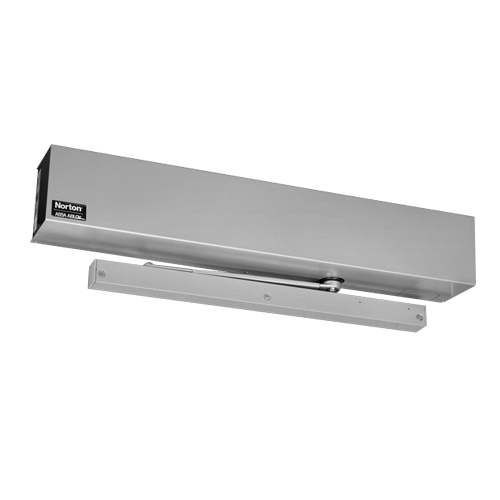
Norton 5700 Series: Push Side or Pull Side Operator for an ADA Door
Posted by Kent on 25th Sep 2026
The operator is easy. Picking push side or pull side is where orders go wrong
Adding hands-free door operation to an existing opening, a doctor's office, a school entry, a retirement facility, sounds like a straightforward retrofit until the order shows up and the arm is mounted on the wrong side of the door. Norton's 5700 Series low-energy operator is built for exactly this kind of retrofit, and the whole family shares one closer body. What separates the three part numbers is which side of the door the arm goes on, and that decision has to be made before you order, not after the operator arrives.
What's actually inside a 5700 Series unit
Every 5700 operator is built from three parts: an inverter, a motor, and Norton's own 1601 closer body. That's not a separate mechanism bolted onto a closer, it's the same 1601 body the trade already knows, running under motor power instead of spring tension alone. It's ANSI/BHMA A156.19 certified as a low-energy operator, which means it's built to stop or reverse if it meets an obstruction, run on adjustable door sensitivity, and time out and close the door on its own about two minutes after an activation signal if nobody's gone through. Power input is 120 VAC, 60Hz, and if the power drops or someone opens the door by hand, it behaves like a normal mechanical closer, spring force and all, not a dead weight hanging off the frame.
5710 pull side, 5730 push side, 5740 universal
The 5710 mounts the arm on the pull side of the door, the side you'd stand on to pull it open. The 5730 mounts on the push side, the side you'd stand on to push it open. Both are handed to that mounting position. The 5740 is the non-handed universal unit, it ships with both a push side and pull side arm in the box, so the installer decides in the field which one the opening actually needs instead of the order desk guessing from a floor plan that may not match what's really at the site.
Push side mounting is generally the stronger choice on an exterior door where wind load or a fire-rated closer requirement favors keeping hardware on the room side, and it's less exposed to weather and vandalism than an arm hanging off the outside face. Pull side mounting is common where the door swings into a vestibule or lobby and the operator needs to be on the exterior face for actuator placement to make sense, or where the frame or adjacent wall doesn't leave room for a push-side arm to travel through its full swing. Neither is universally correct. It depends on which way the door swings, what's on each side of the frame, and where the activation switch or sensor needs to sit relative to the swing.
Why the universal 5740 is worth the extra cost on a retrofit
On new construction, where the swing direction and mounting side are locked in on the plans before the operator is ordered, the 5710 or 5730 is the cheaper, correct call. On a retrofit, where the existing door, frame condition, and clearance around the opening might not match what a spec sheet assumed, the 5740's two arms in one box remove the guessing. An installer who shows up and finds the wall return too shallow for a push-side arm's travel can mount pull side instead without a second order and a second trip. That flexibility is the entire reason to spend more on the universal unit over the handed ones, not a general upgrade, a specific hedge against field conditions you can't fully verify from an office.
Minimum door width and what else has to be true before you spec one
Norton specs a 29" minimum door width for a single door and 30" for a double on the 5700 Series, and the unit covers closer sizes 1 through 6 with adjustable spring power, so it isn't locked to one door weight. Confirm the door meets the minimum width and that the header has room for the operator housing before ordering, an operator that doesn't physically fit the opening is a bigger problem than picking the wrong arm side. Also confirm what's actually triggering the door: a wall-mounted push plate, a wave sensor, a card reader relay, the operator itself doesn't include the activation device, and the choice of activation hardware can influence which side of the door needs the switch, which feeds back into the push-side-or-pull-side decision.
What doesn't change across the three units
All three run on the same 1601 closer body, the same aluminum finish, the same overload safety shutoff that protects the motor and inverter if the door gets obstructed repeatedly, and the same manual operation fallback if the power or the motor drive isn't engaged. Picking 5710, 5730, or 5740 is entirely about which side of the door the arm needs to be on, not about capability or durability differences between the three.
Every unit in the family ships from stock. For a manual institutional closer on the same class of heavy-traffic door, see the Norton 7500 piece, and for picking the right arm configuration on a manual closer, the Norton 8000 Series arm guide covers that decision. All three 5700 units are stocked at the Norton hub.
Common questions
Do I need an ADA-compliant activation switch to use a 5700 Series operator?
The operator itself is ANSI/BHMA A156.19 certified as a low-energy unit, but the activation device, a push plate, sensor, or card reader relay, is ordered separately and should meet ADA reach and operable-force requirements on its own.
What happens if the power goes out while a 5700 operator is installed?
It operates as a standard mechanical closer using spring force, the same as if the motor and inverter weren't there. It doesn't lock people out or leave the door unable to close.
Can I mount the 5740 universal unit and decide the side later?
Yes. It ships non-handed with both a push side and pull side arm included, so the installer picks the correct side in the field based on the actual door and clearance conditions.
What's the minimum door width for these operators?
29 inches for a single door, 30 inches for a double door, per Norton's published spec for the 5700 Series.
Is a 5700 Series operator the same thing as an automatic sliding door operator?
No. This is a swing-door operator built around a standard closer body, not a sliding or revolving door system. It automates an existing hinged door, it doesn't replace the door type.