
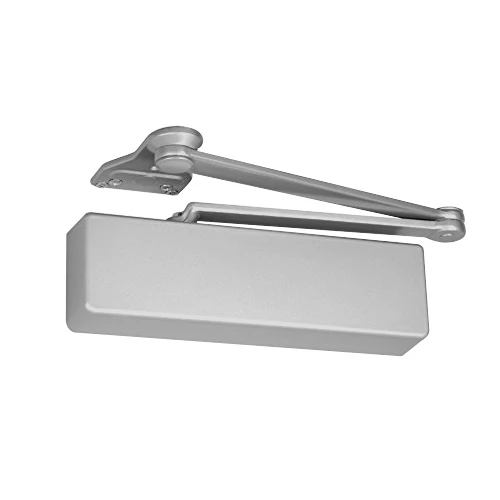
Norton 7500 Closer Arms: PR, CLP, CPS, J and Slide Track
Posted by Kent on 16th Oct 2026
Same closer body, nine different arms
The Norton 7500 is an institutional non-hold-open closer: cast aluminum body, rack-and-pinion, staked valves, a 1-1/2" diameter piston, adjustable spring sizes 1 through 6, a 2-3/16" projection and a backcheck positioning valve. The listings say it exceeds 25 million cycles, witnessed and verified by UL, and is certified to ANSI/BHMA A156.4, Grade 1. All are non-handed, in aluminum finish 689.
What changes from one part number to the next is the arm. The prefix or suffix on the number tells you which one. Pick the arm by the door, not by habit.
PR7500: parallel rigid arm
The PR7500-689 has a parallel rigid arm. The catalog calls it an enhanced variation of the standard parallel arm, intended for heavy traffic areas where auxiliary door stops are installed. The stop matters. A parallel arm sits flat against the door and the stop keeps the door from swinging past what the arm can take.
CLP7500 and CPS7500: the CloserPlus arms
The CLP7500-689 has the CloserPlus arm. The catalog says it is intended where an auxiliary door stop cannot be used and no more than moderate abuse is anticipated. The CPS7500-689 is the same with an added steel buffer spring that gives greater protection at the end of the opening cycle. If someone is going to throw the door open against a wall, the buffer spring is what you pay for.
J7500 and JL7500: top jamb only
The J7500-689 and the JL7500-689 are top jamb installations for reveals from 2-3/4" to 7". The J opens to 150 degrees. The JL opens to 180. Both include the 7786 backplate. A top jamb mount keeps the arm off the door face, which helps in a corridor where the arm would catch carts or hands.
7500ST and PS7500ST: slide track
The 7500ST-689 has a pull side slide track arm. The PS7500ST-689 is the push side version. The catalog describes both as slide track arms, mounted on the pull side or the push side of the door as the part number says. Order the side that matches where the closer will sit. The listings do not give a drawing on the page, so confirm the side against the door swing before you order.
7540ST and PS7540ST: low profile slide track
The 7540ST-689 is the pull side low profile slide track. The PS7540ST-689 is the push side one. The catalog lists these as low profile slide track arms. I do not have the profile measurement on the page, so check the drawing for the clearance if space is the reason you are looking at them.
Side by side
| Part | Arm | Mounting | Use it where |
|---|---|---|---|
| PR7500 | Parallel rigid | Parallel arm | Heavy traffic, door stop installed |
| CLP7500 | CloserPlus | CloserPlus arm | No stop possible, moderate abuse |
| CPS7500 | CloserPlus spring | CloserPlus spring arm | Same, plus end-of-swing buffer |
| J7500 | Top jamb | Reveals 2-3/4" to 7" | To 150 degrees |
| JL7500 | Top jamb | Reveals 2-3/4" to 7" | To 180 degrees |
| 7500ST / PS7500ST | Slide track | Pull side / push side | Slide track by swing side |
| 7540ST / PS7540ST | Low profile slide track | Pull side / push side | Where the standard track is too bulky |
Picking by door
Is there a wall stop or floor stop? If yes and the traffic is heavy, the parallel rigid arm is what the catalog points you to. No stop, moderate use: CloserPlus, and the spring version if the door gets thrown open. Deep reveal and a door that has to clear a wall: top jamb. Closer on the push side or a track arm wanted: slide track, in the side the door calls for.
Where this goes wrong
Two common mistakes. The first is ordering a CloserPlus arm for a door with a heavy abuse history. The catalog is clear that it is for moderate abuse. The second is ordering by the series alone and getting a closer with the wrong arm for the door. The 7500 is not one part. Also, the spring size is adjustable from 1 through 6, so the door width and weight decide the setting, not the part number.
What stays the same on every 7500
Because the body is shared, the performance numbers are the same on every part in this guide. The rack-and-pinion mechanism, the cast aluminum body, the staked valves and the 1-1/2" piston do not change with the arm. Spring size is adjustable from 1 through 6, so you tune the closer to the door on site rather than ordering a different part. The self-drilling screws are in the box.
The backcheck positioning valve is on all of them too. Backcheck slows the last part of the opening swing, which is what protects the wall, the stop and the arm from a door that gets thrown open. If you are weighing a plain CloserPlus against the spring version, the backcheck helps with the same problem from a different direction.
Why institutions specify the 7500
The catalog describes the series as ideal for interior or exterior doors in facilities that demand reliability. In practice that means schools, hospitals and municipal buildings, where a door cycles hundreds of times a day and maintenance does not want a call every month. The non-hold-open feature is the part that matters for a door that must close, such as a stairwell or a corridor door that the building policy says does not stay open.
If you want a hold-open closer, this is not the line. Look at other Norton series for that.
Common questions
Is the 7500 a hold-open closer?
No. The catalog lists the whole line as non hold open.
Are these handed?
The listings say non handed.
What is the difference between J and JL?
Both are top jamb only. J goes to 150 degrees, JL to 180.
Do I get the backplate?
The J and JL listings state the 7786 backplate is included.
Our Norton door closer page lists the full range. For the overall series, see the Norton 7500 abused door guide. For arm choices on the 8000 series, see the 8000 arm guide. Tell us the door and the reveal and we will match the arm.