
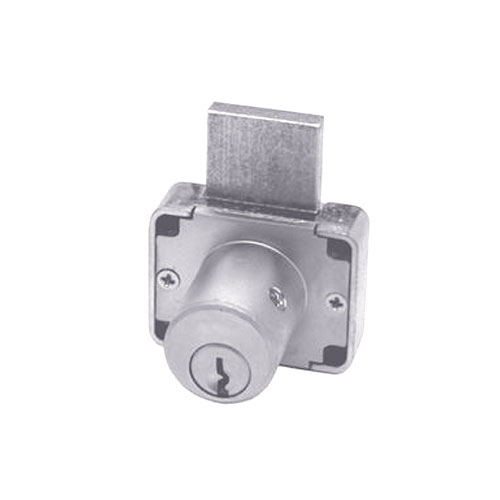
Olympus 200DW: Keyed Alike or Keyed Different Drawer Lock
Posted by Kent on 27th Sep 2026
One Key or Twenty: Decide Before You Order the Locks
A property manager reordering deadbolts for a bank of file cabinet drawers called last spring wanting "the same lock as before, just more of them." He had ordered keyed-different the first time because it was the only option the old vendor mentioned, then discovered on move-in day that his staff needed a separate key for every single drawer in a twelve-drawer credenza. Nobody had asked him whether the drawers should share a key. That question has to get answered before the order goes in, because keyed-alike and keyed-different are not the same lock with different labels. They are a decision about who carries how many keys, made before the order goes in rather than discovered on move-in day.
The Olympus 200DW is an N Series drawer deadbolt cabinet lock: 7/8" barrel, 4-pin, zinc die-cast body, non-handed, key removable in the locked position, rekeyable in the field through a set-screw cylinder release. Every 200DW ships in Satin Chrome with two keys included, and the lock itself is identical in every mechanical respect between the two versions covered here. The one variable that changes which SKU you order is whether that key also opens the drawer next to it, and that single choice is the whole reason two part numbers exist for what looks like the same lock.
200DW-KD: Every Drawer Gets Its Own Key
The 200DW-KD-26D-7/8 is keyed different. Each lock cuts to its own bitting, so the key that opens one drawer does not open the next one over, even in the same cabinet run. This is the right call for individual employee storage, shared office furniture where each person's drawer needs to stay private from the coworker at the next desk, or any application where "my key should not open your drawer" is the actual security requirement.
200DW-KA101: The Whole Bank Opens on One Key
The 200DW-KA101-26D-7/8 is keyed alike, factory-cut so every lock ordered under the same keying group (KA101) opens on one identical key. This is the right call for file storage, a bank of supply drawers, or a multi-drawer credenza where one person or one department manages access and does not want to carry a separate key for every drawer they open ten times a day, let alone track which key belongs to which drawer.
Olympus lists more than one keyed-alike group for the 200DW line, including KA103, KA107, and KA915. Each group number is a separate factory keying batch. Locks ordered under KA101 will not share a key with locks ordered under KA103, even though both are technically "keyed alike" products. If you are ordering in more than one batch over time, note the exact group number on the purchase order and keep it on file, because alike only means alike within the same group, not across the whole product line. A second order placed six months later under the wrong group number means a second, incompatible key showing up for drawers that were supposed to match the first batch.
Why This Matters More Than It Looks Like It Should
A drawer lock feels like a small purchase next to a mortise lockset or an exit device, and the cost difference between KD and KA is nothing. The cost that actually matters is downstream: replacing a wrong-keyed lock later means pulling a mounted lock body out of an installed drawer front, ordering the correct SKU, and reinstalling it, all while the drawer sits unusable. Getting the keying decision right at order time is a five-minute question. Getting it wrong is an afternoon of rework per drawer, multiplied by however many drawers went in on the same order.
What Doesn't Change Between Them
Barrel diameter, finish, pin count, and the rekeying mechanism are identical whether you order KD or KA. Both use the same 7/8" barrel and both are rekeyable through the set-screw cylinder release without pulling the whole lock body out of the drawer front. That matters later: if a keyed-alike group ever needs to be split off from the rest (an employee leaves, a drawer changes owners), the lock can be rekeyed in place rather than replaced.
The Question to Ask Before You Order
Count the drawers, then ask who needs access to which ones. A single desk pedestal for one employee is almost always keyed different by default. There is nobody else who needs the key. A filing room, a mailroom bank of parcel lockers, or a shared supply cabinet is almost always keyed alike, because the point of the lock is controlling outside access, not separating insiders from each other. Mixing both inside the same furniture run is normal: private employee drawers keyed different, shared file drawers on the same credenza keyed alike to a common group. Just order each set under the correct SKU rather than assume the vendor will sort it out.
Common questions
Can I rekey a 200DW-KD to match an existing keyed-alike group later?
Not to an existing factory group. The set-screw release lets you rekey the lock in the field, but matching a specific factory keying group requires ordering new locks under that group number rather than field-cutting to match. Talk to us about the group number before you buy if there is any chance you will want to add matching locks later.
How many keys come with each lock?
Two keys per lock, standard on every 200DW SKU regardless of keying option.
Does keyed-alike mean every 200DW we ever order will share one key?
No. Keyed-alike only applies within the specific group number ordered (KA101, KA103, and so on). Different groups do not share keys with each other even though both are "keyed alike" in the general sense.
Is the 200DW handed? Do I need a left or right version?
No. It's non-handed and installs the same way regardless of which side of the drawer the lock sits on.
What's the difference between the 200DW and Olympus's other cabinet locks?
The 200DW is specifically a drawer deadbolt. For a cabinet door instead of a drawer, or for SFIC-compatible cores tied to a building's existing keying system, a different Olympus body is the right part. Tell us which application and we'll point to the right one.
Shop the full Olympus Lock cabinet and cam lock line for more configurations, or read how the DCR4 and DCN4 cam locks handle keyed-alike filing cabinets and how the Olympus 725 matches a cabinet lock to your building's SFIC cores when a drawer deadbolt isn't the right fit.