
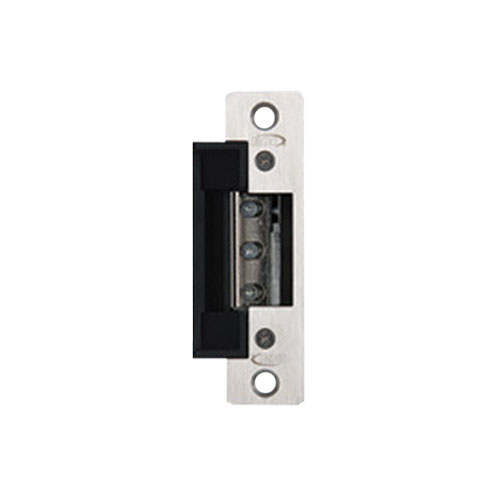
RCI 7104 vs 7105 vs 7107 vs 7108 Electric Strike
Posted by Kent on 7th Oct 2026
Four strikes, one design, four faceplates
The RCI 7 Series adjustable electric strike comes as the 7104, 7105, 7107 and 7108. They look like one product with four numbers, and for the most part they are. The strength rating and the basic design are the same. What changes is the faceplate size, and on some of them the backset. The faceplate decides whether the strike fits the cutout already in your frame, so that is the number to settle first.
RCI lists this strike for aluminum, cylindrical, centerline mortise lock and exit device applications. The adjustment is the selling point: you slide the strike pivot horizontally to line it up with the latch, and the design resists being rattled open by vibration. The coil is not polarity conscious, so crossed wires on the low voltage leads will not hurt it.
What all four share
- Static strength: UL listed to 500 lbs.
- Fail mode: fail locked, which means fail secure.
- Handing: non-handed.
- Adjustment: 1/8" horizontal.
- Burglary rating: UL 1034 burglary-resistant.
- Latch projection: accommodates 5/8".
- Cutout depth: 1-1/2", which the listing says fits most aluminum and wood frames.
- Door thickness: 1-3/8" to 2-3/8".
- In the box: mounting tabs, fasteners and trim plate.
- Finish: brushed stainless steel, the 32D in the part number.
Fail secure matters. The door stays locked when power drops, so this is not the strike for a door that must release on a power loss. For that you need a fail safe strike, and this is not one.
The faceplate sizes
- 7104: 1-1/4" wide by 4-7/8" high, ANSI round corners.
- 7105: 1-1/8" wide by 5-7/8" high, round corners.
- 7107: 1-1/4" wide by 6-7/8" high, round corners.
- 7108: 1-7/16" wide by 7-15/16" high, round corners.
Measure the plate on the old strike, or the opening in the frame if you are replacing something else. Match height and width. Only the 7104 is called out as ANSI in the listing, so a frame cut for the standard ANSI strike is the 7104 job. The 7104-01-32D is the reference listing.
Backset: read this before you order
The listing for the 7104 says the backset is adjustable from 2-3/8" to 2-3/4". The 7108 listing says fixed 2-3/8". The 7105 and 7107 listings do not state a backset, so I will not give you one. What the listings that mention it do say is that the 7100 series is offered in more than one backset and that they are not interchangeable. Confirm the door's backset first. If your lock is 2-3/4" and you pick a fixed 2-3/8" strike, the two will not meet. Send us a photo of the edge or the model of the lock and we will check it against the listing.
The voltage suffix
The part number carries a code that tells you the voltage. On the 7104 and the 7105 we confirmed all four suffixes against the listings:
- -01: 11 to 16 VAC.
- -05D: 12 VDC.
- -07: 24 VAC.
- -08D: 24 VDC.
The 7107-01 and 7108-01 listings also read 11 to 16 VAC, and the same four suffixes are listed for them. Read the voltage line on the exact listing before you order, and match it to the power supply on the job. In my experience a DC coil is the quiet choice, and an AC coil can hum in a quiet lobby. That is field experience, not a spec from the listing.
Setting one up
The adjustment is what saves the install. Mount the strike, close the door slowly with the power off, and see where the latch lands against the opening. Slide the pivot until the latch sits square, then lock the adjustment down. Do this before you pull wire. A strike that is a sixteenth off will bind on a cold morning and have the customer calling you back. After it is set, power it up and cycle it a dozen times with the door open and then with the door closed and the latch loaded. Loaded is the test that matters, because a strike that releases easily with the door open can still hang up under a little pressure from a door that does not quite close flush.
The listing says the design prevents manipulation by vibration. That helps on a door that gets slammed, but it does not replace good alignment. Do not count on the feature to forgive a sloppy install.
When a strike is the wrong answer
These are cutout strikes for centerline latches. If the door has no frame cutout to give and you cannot make one, or the lock is a different type entirely, a maglock may be the better fit. If the door has to release on power loss for life safety, do not use any fail secure strike without the code official's sign-off. Say what the door is for, and we will tell you straight if a different part makes more sense.
Prices
In our catalog the 7104 is $137.40, the 7105 and 7107 are $142.20, and the 7108 is $148.20. That is a small spread. Do not pick a strike by price. Pick the one that fits the cutout, because a strike that does not fit costs a lot more than $11.
Which one
- Standard ANSI cutout, shortest plate: 7104.
- Plate 1-1/8" by 5-7/8": the 7105-01-32D.
- Plate 1-1/4" by 6-7/8": the 7107-01-32D.
- Tall 7-15/16" plate and a 2-3/8" backset: the 7108-01-32D.
Before you order
- Measure the existing cutout, width and height.
- Confirm the lock backset.
- Check the door thickness, 1-3/8" to 2-3/8".
- Check the power supply voltage and whether it is AC or DC.
- Confirm the door can stay locked when power fails.
Common questions
Is the RCI 7 Series fail safe?
No. The listings say fail locked, fail secure.
Do the strikes come with a trim plate?
Yes. Mounting tabs, fasteners and trim plate are included.
Can I swap a 7104 for a 7105?
Not without checking the faceplate. The sizes differ, and so can the backset.
What do the -01 and -05D mean?
They are voltage codes. -01 is 11 to 16 VAC and -05D is 12 VDC.
Will the strike work on a pair of doors?
The listing does not say. Send us the opening and we will check.
The full RCI range is on our RCI hub page. If the opening is too small for a strike and a magnetic lock fits better, read the 8371 MiniMag guide. For help deciding between a strike and a maglock, see this comparison.