
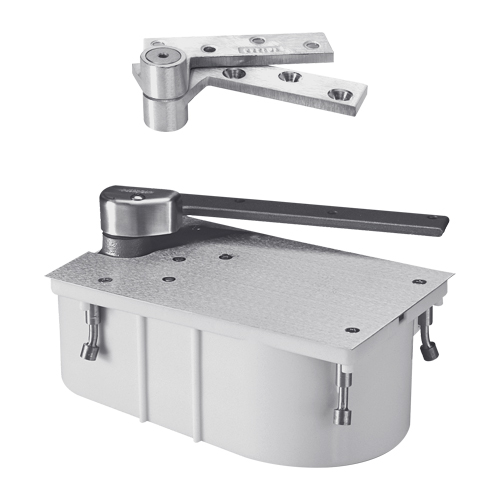
Rixson PH27: A Floor Closer That Meets ADA Opening Force on a Heavy Door
Posted by Kent on 25th Sep 2026
Why a heavy door can fail an ADA check even with a good closer on it
A floor closer earns its keep on a heavy glass entrance or a pivoted door too big for a surface closer to handle cleanly. The problem shows up later, after the door is hung and someone runs an opening-force test with a gauge, because the same spring tension that lets a 3/4" offset pivot control a heavy door closing also makes that door hard to push open from a stop. ADA and ANSI A117.1 cap interior door opening force at 5 pounds, and a standard-duty floor closer sized for a heavy glass door will often read well over that. Rixson builds a version of its 27 Series specifically to bring that number down without changing anything else about the closer.
What the PH designation actually changes
The Rixson PH27 is the standard 27 Series body with a lighter opening-force spring calibration built in, sold under the name Rixson uses for it on the cut sheet: Physically Handicapped Opening Force. Everything else on the closer is the same 27 Series hardware a locksmith already knows: 3/4" offset hung spindle, cast-iron case set into the floor, adjustable closing speed and latch speed valves, and the same satin chrome (626) finish on the cover plate. The only thing the PH kit changes is how much force it takes to start the door moving. That is a narrow fix for a narrow problem, and it is the right one when the door itself, the glass, the width, isn't changing, but the force reading on the compliance test is.
It does not turn a heavy door into a light one for closing purposes. The closer still has to bring a wide glass leaf back to latch reliably, and Rixson's spring and valve adjustments on the 27 body handle that the same way they do on the standard unit. What changes is the resistance a person feels on the push side when the door is sitting at rest, which is exactly the number an inspector or a facilities manager with a force gauge is checking.
When you actually need the PH version instead of the standard 27
Order the PH27 when the door in question is subject to an ADA opening-force requirement and a standard 27 has already failed a force check, or when you know ahead of time that the opening is on a public accessible route and you don't want to gamble on the standard spring calibration passing inspection. Order the standard Rixson 27 when the door isn't on an accessibility-regulated path, an interior mechanical room, a loading corridor, a door the public doesn't use to enter or exit the building, where the extra spring tension is a feature, not a liability. A lot of buyers default to the standard 27 because it's the one they've ordered before, then get a force-test failure on a lobby or storefront door that turns into a second order and a second install trip. If the door is public-facing and accessible, spec the PH27 the first time.
This is also the fix to reach for before you start looking at the door closer as the problem in isolation. A heavy glass door with a strong prevailing wind load or a poor threshold seal can still read high on a force gauge even with the PH spring in place, because opening force on a real door is a function of the whole assembly, not the closer alone. Rule out a binding pivot, a dragging weatherstrip, or a door that's simply too heavy for a floor closer at all before assuming the PH kit alone will pass a stubborn opening.
Get the handing right before you order
Rixson floor closers are handed, LH and RH are different cases, not a field-reversible arm the way a surface closer sometimes is. Stand on the pull side of the door, outside the swing. If the door is hinged on your left and swings away from you, it's left hand. Hinged on your right, it's right hand. A floor closer case gets set into the slab before the door and frame go in, so ordering the wrong hand on a floor closer is a worse mistake than on a surface unit, you're not just remounting an arm, you're pulling a case out of concrete. Confirm handing against the actual frame, not the plan set, before the order goes in.
What stays the same regardless of which one you order
Both the standard 27 and the PH27 use the same offset hung pivot geometry, the same adjustable spring power range on the closing side, and the same top and bottom pivot hardware. Neither changes the door's fire rating on its own, and neither is a substitute for confirming the full pivot set, top pivot, intermediate pivot if the door needs one, and the floor closer itself, is specified as a matched set. A floor closer swapped onto a pivot set from a different manufacturer is a common field mismatch that shows up as a door that binds or won't self-close correctly, and it has nothing to do with which spring calibration is inside the case.
Every 27-body variant ships from stock. For the base 27 Series install and a broader look at when a floor closer is the right call over a surface unit on a heavy pivoted door, see the Rixson 27 floor closer piece. If the question on your job is whether to spec a hold-open version instead of a plain closer, 27-180N vs 27-180A covers that decision. Both are stocked at the Rixson hub.
Common questions
Does the PH27 close a heavy door slower than the standard 27?
Not by design. The PH kit changes the opening-force spring calibration, not the closing speed adjustment, which is set independently with the same valves as the standard 27. A properly adjusted PH27 still closes and latches a heavy door reliably.
Can I retrofit a standard 27 into a PH27 in the field?
No. The opening-force calibration is built into the closer at the factory. If a door fails a force check with a standard 27 installed, the fix is ordering a PH27 unit, not adjusting the existing closer's valves past their intended range.
What's the actual ADA opening force limit I'm testing against?
ADA and ANSI A117.1 set 5 pounds of force as the maximum to open an interior, non-fire-rated door. Fire doors and exterior doors have different, generally higher, allowances. Confirm the exact limit for your door type with your local code official before a compliance test.
Do I need a PH27 on every accessible door in the building?
Only where a floor closer is already the right hardware choice, a heavy or pivoted door, and where the door is on an accessible route. A standard cylindrical lock door with a lighter surface closer usually isn't in floor closer territory at all.
Is the PH27 available in a right-hand version?
Yes, both LH and RH are stocked in satin chrome (626). Confirm handing from the pull side before ordering, since the case is set into the floor and isn't field-reversible.