
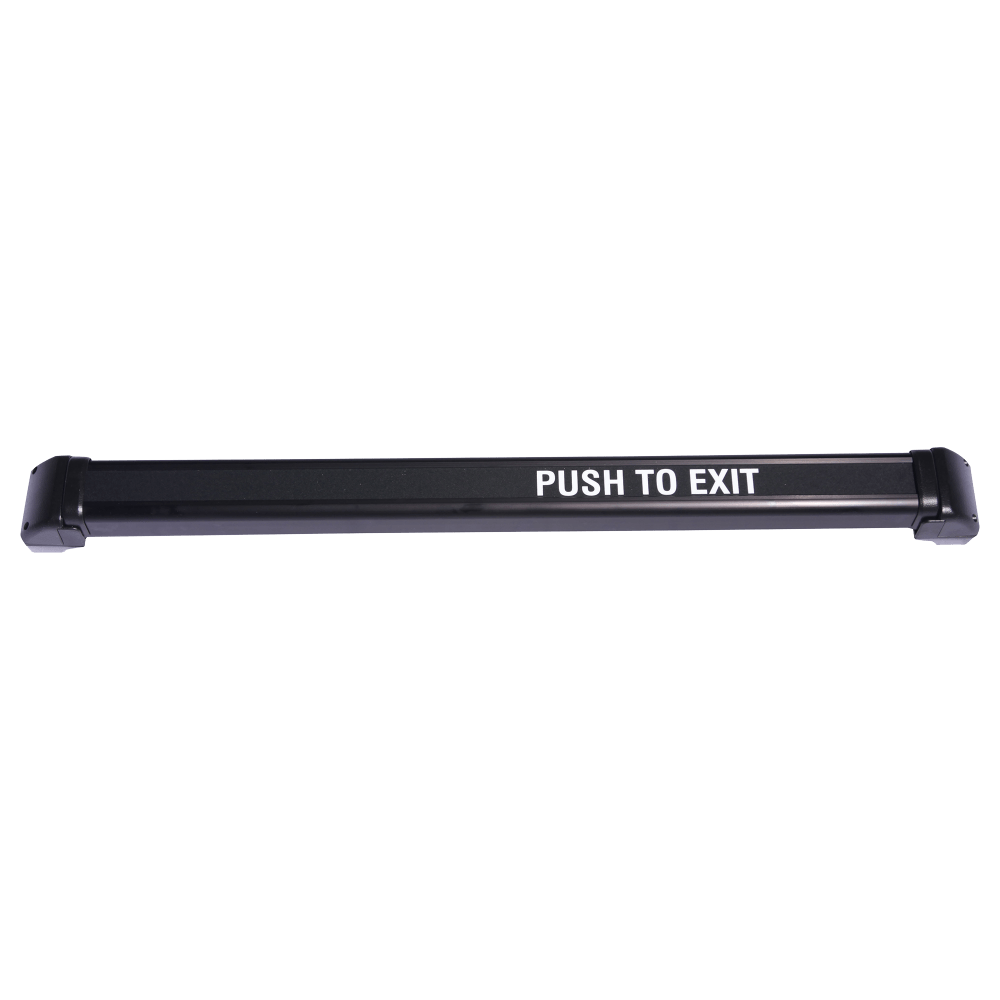
Securitron DSB, EL-DSB, EMB, WEMB Maglock Exit Bars
Posted by Kent on 19th Oct 2026
A maglock door still has to let people out
A magnetic lock holds a door shut until power is cut. That makes the release device the most important part on the door. It is the thing a person in a hurry reaches for. If it fails, they are trapped. So the code is firm about it: free egress with no special knowledge or tools, and a release that does not depend on a single switch.
Securitron makes the bar that does this on a magnalock door. This article sorts the four we stock: the DSB, the EL-DSB, the EMB and the WEMB. They look alike on the shelf. They are not the same part.
The four bars side by side
| Part | Type | How it releases | Where it goes |
|---|---|---|---|
| DSB-BK | Dual sense bar, black anodized | Touch sense plus mechanical movement, two independent switch circuits | Interior doors |
| EL-DSB-CL | ElectroLynx dual sense bar, clear anodized | Same as the DSB, built for ElectroLynx | Interior doors |
| EMB-BK | Electromechanical bar, black anodized | Push the bar, internal switches open the circuit | Interior doors |
| WEMB-BK | Weatherproof electromechanical bar, black anodized | Push the bar, waterproof switches | Outdoor applications |
The listed standard length on all four is 36 inches.
Dual sense: touch and movement
The DSB is the more refined bar. It has two independent circuits. One senses a touch. The other is a mechanical switch that fires with movement of less than 1/8 inch. Either one releases the lock. The idea is fault tolerance: if one circuit fails, the other still lets the person out. The listing says it is built to address current building and life safety codes, and that it is not for fire-rated doors.
It also lists the features that matter in a building full of electronics. The circuit board is immune to electrostatic discharge, including from switching power supplies, proximity and garment readers and neon signs. It resists discharge up to 27,000 volts, is bounce resistant to false triggering from outside impact, and runs on either 12 or 24 VDC.
The EL-DSB-CL is the same bar listed as ElectroLynx ready hardware, in clear anodized. If the opening uses Securitron's ElectroLynx wiring system, that is the one. If it does not, the standard DSB is the right pick. The listings do not describe the ElectroLynx wiring itself, so ask us if you are not sure which system the door has.
Electromechanical: push it and it opens
The EMB works differently. You push the bar. Internal switches release the lock. The listing calls out four individual switches for redundant, fault-tolerant operation and a low profile with only 1/4 inch of movement to activate. It outputs a DPDT 5 amp rated contact, which will either allow free egress or start the delay on an exit delay timer.
That last point is the second use. The EMB and the WEMB are listed as initiate devices for a delayed egress timer. If the opening has a delay, the bar starts the clock. Our article on the XDT delayed egress timers covers the timer side of that arrangement. Delayed egress carries its own code requirements, so confirm the authority having jurisdiction accepts it before you wire one.
Weatherproof is a switch, not a coat of paint
The WEMB is the EMB with waterproof switches. That is the difference the listing gives. It says the switches allow the bar to work in outdoor applications, and that the metal construction stands up to the toughest environments. The plain EMB lists rugged interior environments. If the door is exposed to rain or hose-down, the WEMB is the one. If it is inside, you do not need it.
The DSB and EL-DSB list interior use only. Do not hang one on an exterior door because it looks nice.
Picking one
- Interior door in a busy building with lots of electronic gear. The DSB. The ESD resistance is why it exists.
- ElectroLynx opening. The EL-DSB.
- Interior door with a delay timer. The EMB, as the initiating device.
- Outside, or anywhere wet. The WEMB.
- Door is fire rated. None of these. The listings say non-fire-rated doors.
Replacing an old bar
If you are swapping a bar that is already on the door, the mounting pattern is the first thing to check. The DSB and EL-DSB list a mounting pattern similar to the TSB-3. The EMB and WEMB list a pattern similar to the TSB-3 and the DSB, and say they retrofit easily to most competitors' mounting patterns. Similar is not identical. Hold the old bar against the new part number's dimensions and check the screw holes before you plug the old holes with filler.
The 36 inch length is the standard. On a narrow door, the DSB is the only one of the four that lists field cutting to fit. If the door is a 30 inch leaf or a pair of narrow doors, that matters. Plan the length before you order, because a cut bar is a bar you cannot return to full length.
Wire it as the instructions say, and test the release with the power on, with the power off and with one circuit disconnected if the bar is a dual-circuit type. A bar that passes only one of those tests is a bar that has not been tested.
What they include and what they do not
Each listing includes 16 feet of 22 AWG 6-conductor cable and an armored door cord. The DSB listing says it can be field cut to fit non-standard door widths. The bar does not include the lock, the power supply or the door position switch. Pair it with the right emergency exit button if the code wants a second release at the door, and read why a maglock fits a door you cannot mortise if you are still choosing the lock itself.
Common questions
Which bar is for a delayed egress door?
The EMB and the WEMB are listed as initiate devices for an exit delay timer.
Which bar works outdoors?
The WEMB, with its waterproof switches.
Is any of these fire rated?
No. The listings say they are for non-fire-rated doors.
What voltage?
The DSB listing gives 12 or 24 VDC.
What lengths?
Standard length is 36 inches on all four. The DSB can be cut to fit non-standard doors.
The full range is on our Securitron page. Tell us the door, the lock and whether it is inside or out, and we will confirm the bar.