
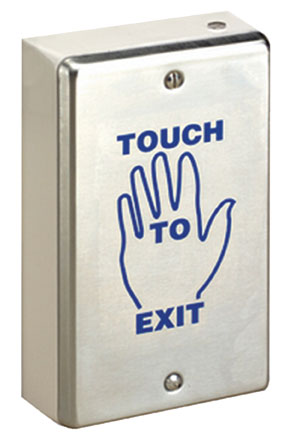
Securitron SP-1 vs KP1 vs PZ1: Touch Plate, Keyswitch, Sounder
Posted by Kent on 17th Nov 2026
Three Securitron single gang plates that sit beside a door
A magnetic lock or electric strike does nothing on its own. Someone has to be able to release it from the secure side, and sometimes someone has to hear that the door is held open. Securitron builds three small plates for those jobs: the SP-1 touch sensor plate, the KP1 keyswitch and the PZ1 piezo sounder. They look similar on the wall. They do three different things.
Two of them release a door and one makes noise. Here is which is which, from the listings, and where each one belongs.
At a glance
| Part | What it does | Operation | Voltage | Rating |
|---|---|---|---|---|
| SP-1 Touch Sensor Plate | Push panel release | Touch, no moving parts | 12 or 24 VDC | DPST relay, 2 amp |
| KP1 Keyswitch | Key release, override or reset | Momentary key turn | 12 or 24 VDC LED | SPDT switch, 7 amp |
| PZ1 Piezo Sounder | Remote alarm sounder | Sounds on signal | Not stated | 86 dB |
All three are stainless steel and made to sit on a single gang opening. The SP-1 and the KP1 are switches. The PZ1 is an annunciator.
SP-1: a push plate with nothing to wear out
The SP-1 uses touch sensing in place of a button. Securitron describes it as a push panel with no moving parts. You touch the plate and the relay trips. It has an internal timer adjustable from 0 to 25 seconds, so the release holds for as long as the person needs to get through, and it has a built-in redundant button. The relay is DPST, rated 2 amps. It runs on 12 or 24 VDC.
The plate is oversized so that it covers a single gang cut-out, which hides a rough hole in the wall. A three part vinyl decal comes with it, and a red LED is built into the back box. The listing says it is recommended for indoor use only, and we take that at its word. If the opening is exterior or damp, this is not the plate.
The plate is the choice where a mechanical button gets abused. A button in a busy corridor or a school gets slapped and pounded for years. A sensor with no moving parts has nothing to wear. It is also easy to see, which matters when people leave in a hurry.
KP1: the momentary keyswitch
The KP1 is a single gang momentary SPDT tubular keyswitch. The listing gives its jobs as exit, door release, manual override or reset. Turn the key and the contacts change state, and let go and they return. It has a bi-color LED for 12 or 24 VDC, a 7 amp SPDT switch, and stainless faceplates with anti-tamper screws. Two keys come with it. It is UL listed.
The switch is momentary, so it releases the lock for as long as the key is held. If you need the key to stay in one position until you turn it back, that is a maintained switch, and the listing for this part does not describe one. We cover the maintained version in our article on the MK and MKA keyswitches.
Use the KP1 where only certain people should release the door: a staff-only exit, a storeroom, an override for the person on duty. A key limits who can do it. It also gives you something simple to reset an alarm or a latched circuit, and the listing names reset as one of its uses. The listing calls it useful for less demanding applications, so it fits a quiet door and does not suit one that is worked all day.
PZ1: the sounder, and why it is not a switch
The PZ1 is a remote alarm sounder. The listing says it is used for exit delay or remote door prop. It is a stainless single gang plate, 4.5 in. by 2.75 in., with anti-tamper screws, and the piezo element puts out 86 dB. It is a remote annunciator, which means it can sit away from the door and sound there.
It does not release anything. It tells somebody that something happened: a door held open past the time, or someone leaving through a delayed door and waiting out the delay. If the door has a timer or a door position switch, the sounder is the thing that tells a person at a desk. We wrote about the timer side in our delayed egress timer article.
The listing does not give an operating voltage for the PZ1, so check that before you wire it to a power supply. Call us with the system and we will confirm.
Putting two together
Most doors that need a release also need something that talks. A staff entry might use a KP1 on the inside and a PZ1 at the desk, so that a door propped open is heard. A corridor exit might use the SP-1 for the release and nothing else. The parts do not depend on each other. Pick each for its job.
What the listings do not say
The listings do not give mounting depth, wire gauge, the SP-1 sensitivity setting, or the PZ1 voltage and current draw. We will not make those up. They also do not say anything about code. A release device on a door that must meet life-safety rules has to meet them, and your local authority has the final word. If a door is a means of egress, ask before you pick a switch.
Common questions
Which Securitron plate is indoor only?
The SP-1. The listing says it is recommended for indoor use only.
Does the SP-1 have a timer?
Yes. The listing gives an internal timer of 0 to 25 seconds.
Does the KP1 stay switched when I turn the key?
No. It is a momentary switch. The contacts return when you let go.
Does the PZ1 unlock the door?
No. It is a sounder only, rated at 86 dB.
How many keys come with the KP1?
Two.
The rest of the line is on our Securitron page. Tell us the door and the lock, and we will pick the plates.