
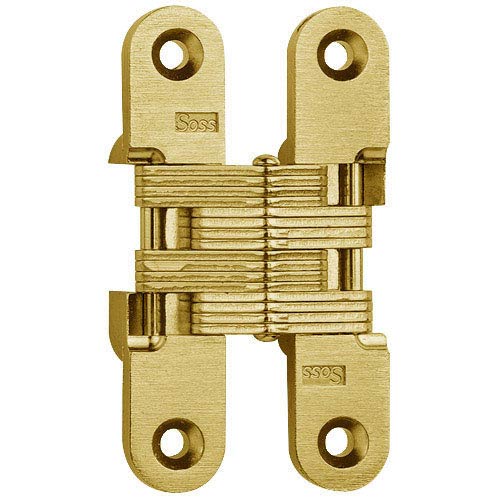
Soss 208, 212 or 216 Invisible Hinge: Match Door Thickness
Posted by Kent on 5th Oct 2026
The number on the hinge is the door thickness
An invisible hinge hides inside the door and the frame, so it needs wood or metal deep enough to hold a full mortise. That is why the Soss model number matters more than the finish. The 208, 212 and 216 are the same style of cabinet invisible hinge, and what separates them is the thickness of the door they will fit. Order the wrong one and you find out at the router, with a door already clamped to the bench.
The catalog gives the minimum material thickness for each. Here is the whole decision in one list:
- Soss 208: 1 in. (25.40 mm) minimum thickness. Wood screws #8 x 1-1/4 in., machine screws #8-32 x 5/8 in.
- Soss 212: 1-1/8 in. (28.58 mm) minimum. Wood screws #10 x 1-1/4 in., machine screws #10-24 x 3/4 in.
- Soss 216: 1-3/8 in. (34.93 mm) minimum. Wood screws #14 x 1-1/2 in., machine screws 1/4-20 x 1 in.
Measure the door, not the frame, and measure it where the hinge goes. A door that is 1-3/4 in. thick clears all three. A cabinet door, a bookcase panel or a thin slab may only clear the 208. If the material is thinner than the number, the hinge does not fit, and a longer screw will not fix it.
What all three have in common
The catalog describes every one of them the same way. They open a full 180 degrees and are single action. They work in wood or metal. When the door is closed you cannot see the hinge from either side. The hinge pin is riveted, so it cannot be tapped out, which is the security point. The moving pivot stays inside the hinge until the door is fully open, so there is no exposed pinch point on the back of the door. The catalog calls all three light duty and non fire-rated.
Take those two terms seriously. Light duty means a bookcase door, a hidden closet, a paneled wall door, a cabinet in a reception area. It does not mean a heavy corridor door that swings all day. For a door that carries real weight, look at the Soss 218 and 220, which we cover separately. And non fire-rated means exactly that: do not put one on a rated opening.
Which one for which door
Thin cabinet door or panel: the 208
The 208 is the smallest of the three. At a 1 in. minimum it fits the thinnest material, and it is the one you reach for on furniture-grade work. In the catalog it comes in satin chrome (US26D), satin brass, unplated and several other finishes, so you can usually match whatever else is on the piece.
Standard interior panel: the 212
The 212 fits 1-1/8 in. stock and larger. The step up from the 208 is a bigger screw, the #10 rather than the #8. If your door is 1-1/8 in. thick or a little more, this is the fit. Read the Soss 218PT guide if the door also needs wiring through the hinge.
Thicker door: the 216
The 216 needs 1-3/8 in. of material, and it takes the largest screws of the group, a #14 wood screw or a 1/4-20 machine screw. A 1-3/8 in. interior door is where it lives. Buy the 216 only if the door is at least that thick.
The 216IC spring closer hinge
The 216IC is a different animal. It is a spring closer built into the invisible hinge. The catalog says it is invisible from either side when the door is closed, the closing rate is adjustable with an Allen wrench after installation, and it can be installed inside the door itself or inside the door jamb. It is for doors 1-3/8 in. thick or more, and the catalog says to use one spring closer for every 75 lbs of door weight.
Weigh the door and count from there. A 150 lb door gets two. The 216IC in satin chrome or satin brass costs a good deal more than the plain 216, which makes sense, because it is doing the work of a closer you cannot see. Use it where a visible overhead closer would ruin the room: a paneled library door, a hidden office door, a wall that is supposed to look like a wall. It is also non fire-rated, so it is not a substitute for a listed closer on a rated door.
Router templates and the install
The catalog lists a router guide template for each size, the 208-IT, 212-IT and 216-IT. The template is described as individually handcrafted, held to the door and jamb with nails, with guide pins that locate the deep mortise. The catalog says to use a 1/2 in. router bit and not to use a resharpened bit. That is the whole story on a first install: template, correct bit, and take your time on the mortise. These hinges sit in a deep, full mortise that helps the screws carry the door, so a sloppy cut shows up as a hinge that binds.
Check the template listing against the hinge you bought before you order it. If you are not sure the template matches, send us the model and we will confirm.
Common questions
What is the difference between a Soss 208, 212 and 216 hinge?
Door thickness. The 208 needs at least 1 in. of material, the 212 needs 1-1/8 in., and the 216 needs 1-3/8 in. The 216 also takes the largest screws.
Can I use a Soss invisible hinge on a fire-rated door?
No. The catalog lists the 208, 212, 216 and 216IC as non fire-rated.
How many Soss 216IC spring closers do I need?
The catalog says one spring closer for every 75 lbs of door weight, on doors 1-3/8 in. thick or more.
Do Soss invisible hinges open all the way?
Yes. The catalog says they open a full 180 degrees and are single action.
Are Soss hinges for wood or metal doors?
Both. The catalog lists them for wood or metal applications.
See every size and finish on our Soss hinges page. Send us the door thickness and weight and we will confirm the model before you order.