
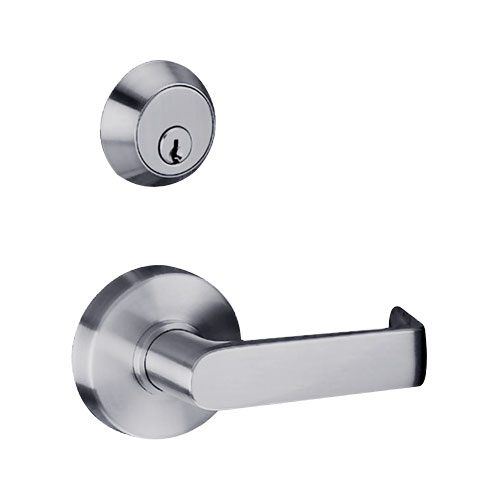
TownSteel MSS-06: A Mortise Function for a Door You Prop Open on Purpose
Posted by Kent on 25th Sep 2026
Some doors need to stay open on purpose, not by accident
Walk any warehouse, school cafeteria, or loading area and you'll find a door propped with a trash can, a wedge, or a folded piece of cardboard during the hours it needs to stay passable. That's a door someone decided should be free-access for part of the day and locked the rest, and the wedge is a workaround for a lock that was never built to do both. TownSteel's MSS-06 Holdback function is the mortise lock that does it properly, on purpose, without a doorstop.
What the holdback function actually does
On the MSS-06, the inside lever can be turned past its normal travel to hold the latchbolt retracted, keeping the door free-swinging and passable without a key, until someone deliberately releases the holdback and lets it relock. That's the whole function in one sentence, and it's the piece a standard storeroom or entry function doesn't have. A storeroom function locks every time the door closes, no exceptions, which is right for a supply closet and wrong for a loading dock door that needs to sit open from 7 to 3 while trucks come and go, then lock itself down for the night.
The outside is still keyed, so a single cylinder MSS-06 keeps the security half of the equation intact. Whoever has the key can lock the outside lever independent of whatever the holdback is doing on the inside, and the latchbolt itself is the same heavy duty sectional mortise case TownSteel builds across the MSS line, not a lighter mechanism swapped in to make the holdback work.
Where a holdback function actually earns its keep
Good candidates are anywhere a door gets propped today: a stockroom door that stays open during a receiving shift, a cafeteria service door propped during meal service, a shop or garage bay door that needs to stay passable during work hours and locked overnight. Anywhere a facility currently solves this with a wedge, a chair, or a piece of tape over the latch, which defeats the lock entirely and leaves the door unsecured any time nobody's watching it, is a candidate for a holdback function instead. The lock does the same job the wedge is doing, on a schedule someone controls, without leaving the door mechanically unlockable the rest of the time.
It's a narrower fit than it sounds. A door that needs to be propped open constantly, all day, every day, with no real need to ever lock it, doesn't need a holdback mortise lock at all, a passage function or an electromagnetic hold-open device tied to the fire alarm is the better and cheaper answer. Holdback earns its keep specifically where the door needs to swing between propped-open and locked-down on a schedule, and where you want that switch to be a deliberate lever action, not a doorstop somebody kicks away by mistake.
Low sectional or full sectional, and the lever it ships with
TownSteel sells the MSS-06 in both a low sectional trim and a full sectional trim, both with the Sentinel lever and both in satin chrome (626). Low sectional trim is the smaller escutcheon, worth checking against your existing door prep or adjacent hardware before ordering, since a low sectional trim replacing a full sectional lock (or the reverse) can leave visible ghosting on the door face from the old plate's footprint. If you're matching an existing MSS installation elsewhere in the building, order the same trim size, not just the same function.
What doesn't change from the rest of the MSS line
The case, the heavy duty sectional mortise body, is the same one TownSteel uses across its office, classroom, storeroom, and entrance functions, so a locksmith already comfortable prepping a door for one MSS function is prepping for the same pocket and the same strike on the holdback version. What's different is entirely in the lever mechanism and how it interacts with the latchbolt, not the case dimensions or the door prep. That matters when a job mixes functions across a building, storeroom on the offices, holdback on the loading dock, entrance on the front door, because it means one prep template covers the whole order.
Both trims ship from stock. For the anti-ligature version of this same mortise body on a patient-room door, see the TownSteel MRX piece, and for the difference between entry/office and classroom function on the standard MSS line, this MSS function comparison covers that decision. Both are stocked at the TownSteel hub.
Common questions
Can the outside still be locked while the inside is on holdback?
Yes. The holdback mechanism controls the inside lever's latchbolt retraction. The outside stays keyed and can be locked or unlocked independent of whatever the inside holdback is doing.
Is holdback the same as a passage function?
No. A passage function never locks at all, it's a simple latch with no keyed cylinder. A holdback function is a fully keyed lock that can be switched between held-open and locked on demand, which is the entire point of specifying it over a passage set.
Should I use a holdback lock or a fire-alarm-tied electromagnetic hold-open instead?
If the door needs to release and self-close automatically on a fire alarm signal, an electrified hold-open device is the code-correct answer, not a mechanical holdback lock. Holdback is for a door someone manually switches between open and locked on their own schedule, not a life-safety release.
What's the difference between the low sectional and full sectional trim?
They're different escutcheon sizes on the same mortise case and the same holdback function. Match whichever size is already on the door, or on adjacent doors in the same building, to avoid visible gaps from the old hardware's footprint.
Does the holdback function work on a door with an existing MSS mortise prep?
The case dimensions match the rest of the MSS line, so a door already prepped for another MSS function is typically ready for the MSS-06 body. Confirm trim size and strike alignment before ordering to be sure.