
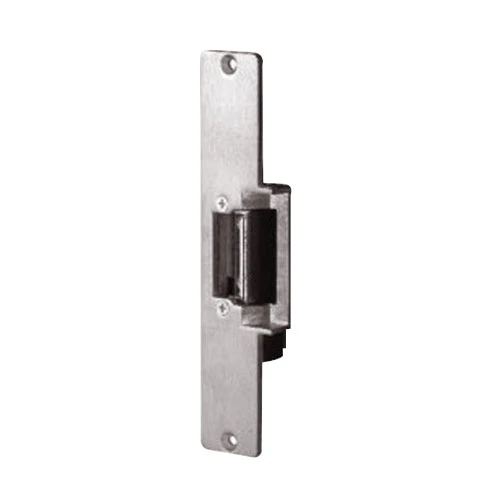
Trine 2000 Series Adjustable Strikes: 2002WR, C, DB, RS
Posted by Kent on 24th Oct 2026
What the 2000 series gives you that a fixed keeper does not
Trine's 2000 series is the adjustable line in its light commercial strikes. The catalog puts it plainly: the adjustable keeper lets you fine-tune latch engagement in the field without shimming. Anyone who has chased a strike on an old building with a door that sags in humid weather knows why that matters. The doors are never square, and a keeper that moves a little saves a callback.
The 2000 series covers a lot of numbers: 2001, 2002, 2007, 2009, 2012, plus letter suffixes. The listings repeat the same description across most of them, so here is what we can state and what we cannot.
The suffixes, decoded from the catalog
- C is satin chrome. The 2009C-6-14AC/DC is listed in satin chrome. Its plain sibling, the 2009-12DC, is brass powder.
- DB is dark bronze. The 2002DB-6-14AC/DC is the dark bronze version of the 2002.
- The plain 2002 is aluminum powder. The catalog lists the 2002-12DC in aluminum powder, while the 2001, 2007, 2009 and 2012 are brass powder unless a letter says otherwise.
- RS is fail safe. The 2012C-RS-24DC is the fail safe version in chrome. Parts without RS are fail secure.
- WR is a special ramp version, covered in the next section.
- Voltage: 12DC, 24DC and the multi-voltage ranges 6-14AC/DC and 16-24AC/DC.
2002WR: the one with a spec sheet in the listing
The 2002WR-24DC has the most detailed description in the series, and it is worth reading closely.
- Use: new or replacement installations in aluminum or hollow metal jambs, for locksets of up to 5/8" throw, based on a 1/8" door gap.
- Auxiliary lever ramps for locksets that have dead-locking levers. Ramp height is 3-3/8".
- Faceplate: 7-15/16" x 1-7/16".
- Adjustment: 1/8" horizontal latch adjustment.
- Holding force: 900 lbs.
- Mortise backset: 1-9/16".
- Power: 24VDC, rated for 500,000 life cycles.
- Finish and latch: aluminum powder, solid cast chrome plated latch. It releases under slight door preload and allows adjustment for wider latch bolts and poorly aligned doors.
The WR in the name is the clue to the ramp. A lock with a dead-locking lever needs a ramp on the strike so the main latch can release. If the lock on the door has that feature, the WR is the one to ask about. If it does not, a ramp is not what you are shopping for.
2001, 2007, 2009, 2012: what we cannot tell you
The catalog descriptions for the 2001, 2007, 2009 and 2012 are identical in text: light commercial mortise locksets, ANSI standard faceplate, adjustable keeper. The finish line in several of those listings says brass powder coat even when the title says chrome or aluminum, so read the product title for the finish, not the description. The listings do not state what mechanically separates a 2001 from a 2007 or 2009, and we are not going to invent a difference. If you are replacing one, match the number on the old unit and the voltage, then confirm the cutout.
For the 2012 specifically, we cover the unknown-voltage case in our 2012 and 2012C article. If you are guessing the voltage of an old strike, start there.
Reading a 2000 series part number
A few examples from the catalog show how the pieces stack up.
- 2009C-6-14AC/DC: 2009, satin chrome, fail secure, multi-voltage 6 to 14 volts AC or DC.
- 2002DB-6-14AC/DC: 2002, dark bronze, fail secure, same multi-voltage range.
- 2012C-RS-24DC: 2012, satin chrome, fail safe, 24VDC.
- 2002WR-24DC: 2002 with the lever ramps, aluminum powder, fail secure, 24VDC.
Using the adjustment well
The 2002WR listing gives a 1/8" horizontal latch adjustment and says the strike releases under slight door preload. That second point is the one people miss. A door that leans on its latch because of wind, a tight weatherstrip or a closer that pulls hard will bind a strike that has to release against that pressure. A strike that releases with the door under preload is the one that keeps working in that building. If the door still fights the strike after you adjust it, the cause is usually the closer or the weatherstrip, and a different strike will not fix that.
The catalog also mentions wider latch bolts and poorly aligned doors and locksets as the case the adjustment is for. That is the realistic use: a retrofit where the lock and the frame were never lined up quite right.
Fail safe or fail secure in this series
Most of the 2000 series parts we stock are fail secure. The door stays locked when power drops, and the strike releases when power is applied. A fail safe part carries RS in the number, and in this series we see that on the 2012C. Whether a fail safe strike is permitted on your door depends on the use of the opening, and that is a call for the code official or the hardware schedule, not for a part number.
Before you pull the old strike
Write down three things first: the number stamped on the old unit, the voltage printed on the coil or the transformer feeding it, and whether the door has been fail safe or fail secure so far. Then measure the faceplate. The 2002WR is a 7-15/16" x 1-7/16" plate, and a cutout that size is not the same job as the shorter plates on the other Trine light commercial strikes. Those three facts and a photo of the keeper let us confirm a match in a few minutes.
Picking one
- Old building, door out of true: any 2000 series, set with the adjustable keeper.
- Hollow metal or aluminum jamb with a dead-locking lever lock: 2002WR.
- Chrome or dark bronze hardware to match: the C or DB part.
- Power supply is 24VDC: choose the 24DC part. Do not rely on a multi-voltage coil if your supply is already known.
If you are sorting out light commercial strikes more broadly, our piece on faceplate size deals with the cutout problem, and the Trine electric strikes page lists the full range. Tell us the lock model and the jamb material and we will point to the right strike before you commit.