
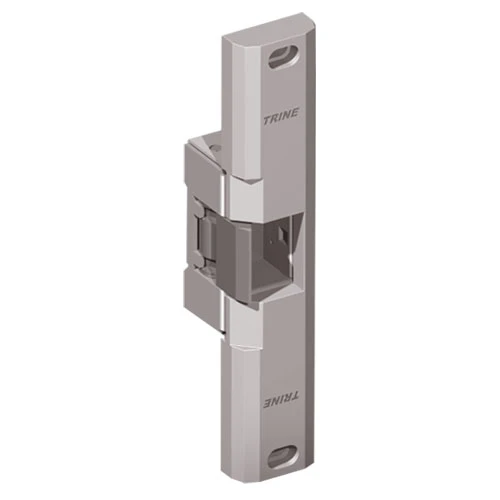
Trine EN400, EN800, EN850: Mortise or Cylindrical
Posted by Kent on 19th Oct 2026
Three Trine EN strikes and the lock that decides it
Trine's EN series has a lot of numbers in it, and the three most often confused are the EN400, the EN800 and the EN850. They share a faceplate size and a listed 24VDC fail secure rating. They do not share a lock. Put the wrong one on a door and the latch does not line up with the keeper, the door will not release, or it will not stay shut.
The question that settles it takes ten seconds. What kind of lock is on the door? Mortise or cylindrical. This article is built around that question.
What each model is listed for
| Part | Lock type | Latch it handles | Faceplate | Listed locks |
|---|---|---|---|---|
| EN400-24DC-US4-RH | Mortise | Up to a 3/4 in. throw latchbolt | ANSI 4-7/8 in. x 1-1/4 in. | Schlage L, Corbin Russwin ML2000, Yale 8800 |
| EN800-24DC-32D-RH | Cylindrical | Up to 1/2 in. latch projection | ANSI 4-7/8 in. x 1-1/4 in. | Schlage ND, Corbin Russwin CL3300, Yale AU and PB |
| EN850-24DC-US10B-LH | Cylindrical, heavy duty | Cylindrical locksets | ANSI 4-7/8 in. x 1-1/4 in. | Schlage ND, Best 9K, Corbin Russwin CL3500, Sargent 10 Line |
All three show fail secure and 24VDC in these listings. Fail secure means the door stays locked when power is lost, and the strike releases when power is applied.
Mortise lock on the door: the EN400
A mortise lock has a lock case set into the edge of the door, with a deadlatch or latchbolt that comes out of it. It is the heavier lock, and a Schlage L-series, a Corbin Russwin ML2000 or a Yale 8800 are typical. The EN400 is the one listed for them, and it handles a latchbolt up to 3/4 in. throw. That throw is the key number: a mortise latch can project further than a cylindrical latch, and the keeper has to be deep enough to hold it.
The listing also notes an adjustable faceplate for field fitting. That matters on older frames where the cutout is not exactly square. The EN800 is listed for only 1/2 in. of latch projection, so on a mortise lock it is the wrong strike.
Cylindrical lock on the door: the EN800 or the EN850
A cylindrical lock is the bored one: a lever or knob with a round hole through the door face and a latch through the edge. Schlage ND, Corbin Russwin CL3300 and Yale AU are typical. The EN800 is listed for these, up to 1/2 in. of latch projection with a deep keeper pocket.
The EN850 is the step up. The listing calls it the heavy-duty version of the EN800 for high-traffic cylindrical applications, with beefier internals for doors that see serious daily use. It lists the same prep as the EN800 and a slightly different lock roster: Best 9K and Sargent 10 Line show up in its list. The listing gives no numbers for what makes it heavier, so I will not invent any. The honest rule is simple. Judge it from the traffic. A door that gets light use is an EN800 job. A school corridor or a hospital entrance is where I would step up to the EN850.
Reading the part number
The part number carries the options. Take EN800-24DC-32D-RH. The EN800 is the model. The 24DC is 24 volts DC. The 32D is the finish, satin stainless steel. The RH is right hand. In the same family, US4 is satin brass and US10B is oil rubbed bronze, which is the finish on the EN850 above.
Handing is the one people get wrong. The strike is handed to the door, so look at which way the door swings and which side the hinges are on before you pick RH or LH. The listing does not walk through the handing rule, and I would not guess on a part you cannot return once it is installed. Send us a photo of the door from the push side and we will confirm.
Outdoor, gates and the weather question
The product titles on the EN800 and EN850 mention outdoor gates. The descriptions themselves give no weather rating, no IP number, and no operating range. So the title tells you where people use them, and the description does not tell you they are sealed. If the strike is going on an exposed gate in a coastal or freezing climate, ask us before you buy and get a specific answer in writing.
When the EN950 is the better pick
If you do not know the lock, or the stock might be either type, the EN950 and EN960 are the universal pair. We cover the choice in the EN950 and EN960 article. The EN950 is listed as fire rated with a 1/2 in. to 3/4 in. latch range, and that makes it the better call when the door has a fire label. The EN400, EN800 and EN850 listings do not say fire rated.
Power before you buy
Match the coil to the supply. These three list 24VDC, so a 12 volt supply will not run them. Our write-up on 12DC, 24DC and 24AC strike coils covers how to read the voltage on a strike you already have. For an apartment door with an intercom release, see the apartment entry piece.
Common questions
Which EN strike for a mortise lock?
The EN400. It is listed for mortise locks with up to a 3/4 in. throw latchbolt.
Which for a cylindrical lock?
The EN800 for standard commercial use, and the EN850 for high-traffic doors.
Are they fail safe or fail secure?
All three listings say fail secure at 24VDC.
What is the faceplate size?
The ANSI 4-7/8 in. by 1-1/4 in., on all three.
Are they fire rated?
The listings do not say so. The EN950 is the one listed as fire rated.
The full line is on our Trine page. Tell us the lock and the door, and we will match the strike.