
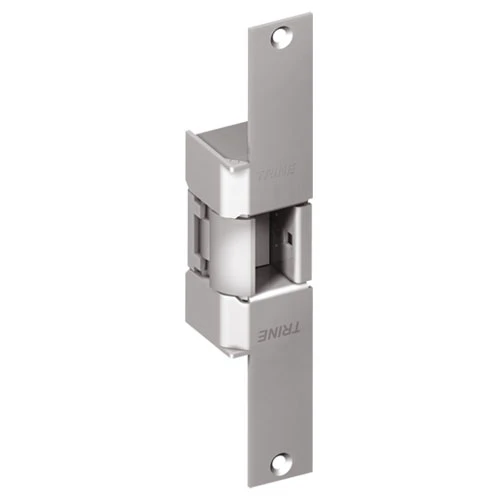
Trine EN950 vs EN960: Universal Strike for Any Lock
Posted by Kent on 9th Oct 2026
One strike for any lock on the truck
Most electric strikes are built for one kind of lock. A cylindrical strike will not take a mortise latch, and the reverse is true. Trine's EN950 and EN960 are the exception: both are universal strikes that handle cylindrical and mortise locksets in one body. They look alike on paper. The difference is how hard the door works.
What they share
From the listings, both strikes use the same universal keeper design and the same prep:
- Faceplate: ANSI 4-7/8 in. by 1-1/4 in.
- Latch throw: the adjustable keeper handles throws from 1/2 in. to 3/4 in.
- Lock types: cylindrical and mortise.
- Mode: the listings we checked are Fail Secure. The door stays locked when power is lost.
- Rating: sold as indoor and outdoor, fire rated electric strikes.
The EN950 listing names locks it works with: Schlage L and ND, Corbin Russwin ML2000 and CL3300, and Yale 8800 and AU series, along with most standard commercial locksets. That is a long list, and it is why the EN950 is the strike a locksmith keeps on the truck when he does not know what he will find behind a door.
EN950: the general purpose universal
Trine describes the EN950 as the strike for "both cylindrical and mortise locksets in one unit." It is the one to buy for an ordinary commercial door: an office, a stock room, a corridor with moderate traffic. Variants in our catalog include EN950-24DC-32D-RH (24 volt DC, satin stainless, right hand) and EN950-12AC-32D-RH (12 volt AC, same finish and hand).
EN960: the heavy duty version
The listing calls the EN960 "the heavy-duty universal strike" for high-traffic conditions. Same universal keeper design as the EN950, but built for doors "getting hundreds of cycles daily." The listing also describes it as the top of Trine's line. Examples: EN960-12AC-32D-LH (12 volt AC, satin stainless, left hand) and EN960-24DC-32D-LH (24 volt DC, left hand).
The listings do not give a cycle rating in numbers beyond that description, and they do not give the holding force. If you need either for a spec, ask us and we will pull the manufacturer data sheet. We will not guess a number.
Which one
Count the cycles. A door that opens a few dozen times a day is an EN950 door. A door that opens all day: a retail entrance, a hospital corridor, a school main entry between classes, the front of a busy medical office. That is an EN960 door. The price difference is small compared with the cost of a second service call, and a strike that wears out fails at the worst time, usually on a Monday morning when everyone arrives at once.
If you are not sure, the EN960 is the safe pick. The EN950 is the pick when the budget is tight and the traffic is known to be light.
Voltage and finish
Both strikes come in more than one coil voltage. In the listings we pulled, the options are 12 volt AC, 12 volt DC and 24 volt DC. The voltage has to match your power supply and your access control output. A 12 volt DC strike on a 24 volt supply runs hot and shortens its life. Check the supply first, and read our EN-CA coil voltage article for the longer version of that story. If you need a transformer for AC strikes, our Trine 598 vs 5205 transformer article will save you a trip.
Finish options in the listings are satin stainless (32D) and US4 (satin brass, in the listings that name it). Match the door hardware. And note that the US4 versions list at a noticeably higher price than the stainless ones, so do not pay for brass if the door does not call for it.
Right hand or left hand
Each strike carries a hand, LH or RH, in its model number. A wrong hand will not seat against the latch. Do not guess the hand from the picture. If you are replacing an existing strike, the old one is stamped or tagged. On a new install, stand outside the door and note which side the hinges are on, then match it to the listing. If the answer is not obvious, send us a photo of the door and the frame.
Fail secure and your life safety plan
A fail secure strike stays locked when power drops. That is right for most doors, because the door stays secure in an outage. But a locked door still has to let people out. The lever on the inside of the door should open the latch regardless of the strike. That is how nearly all commercial locksets work. If the door is part of an exit path, check your local code and your fire marshal. We sell the hardware and we know how it works, but a stamped drawing and an inspector decide what is legal on a given building.
Common questions
Does it fit a Schlage L or ND lock?
The EN950 listing says yes. The EN960 shares the same universal keeper design.
What is the faceplate size?
ANSI 4-7/8 in. by 1-1/4 in.
What latch throw does it accept?
The keeper adjusts for 1/2 in. to 3/4 in.
Is it fail safe or fail secure?
The listings we checked are fail secure.
Can I use it outdoors?
The product line is listed as indoor and outdoor, fire rated. Check the exact model you buy.
See the full line on our Trine page. For a different faceplate problem, our Trine 2012 article covers the other common strike. Send us the lock model, the door traffic and your supply voltage, and we will pick the strike.