
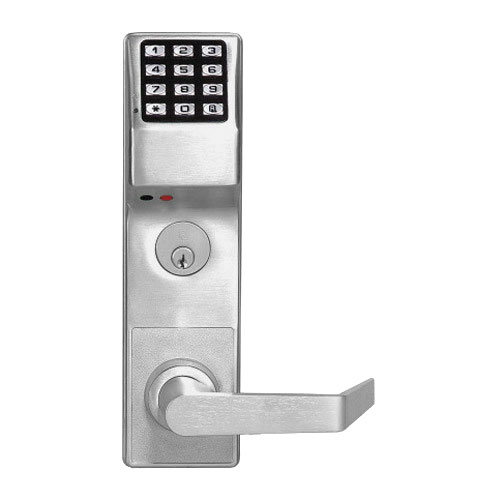
Alarm Lock Trilogy DL3500, PDL3500, PL3500: PIN or Prox
Posted by Kent on 6th Oct 2026
Four Trilogy mortise locks, three ways to get in
Alarm Lock builds the Trilogy mortise line on the same body, so the first thing to settle is what the part number is saying. The catalog breaks it down this way: DL is a digital lock with PIN only, PL is proximity card or fob only, and PDL is proximity plus PIN keypad. The 3500 is the mortise lock. DB is the deadbolt function and R is right hand. US26D is Satin Chrome (626). So DL3500DBR-US26D reads: digital, PIN-only, mortise, deadbolt function, right hand, satin chrome.
All four of the locks in this guide are standalone. No wiring, AA batteries, a built-in audit trail of up to 40,000 events, and 100 to 2,000 users, per the catalog. All four include a Schlage C keyway cylinder for key override, with IC versions available for other keyways.
The four, side by side
- DL3500DBR: PIN only. The user enters a code on the keypad. No keys to lose, no cards to manage.
- PDL3500DBR: PIN or proximity. The user enters a PIN or presents a prox card or fob. A dual-credential setup without a full access control system.
- PL3500DBR: proximity only. A card or fob unlocks the door. No keypad.
- DL4500DBR: a PIN-only mortise lock listed in the catalog as the privacy version of the line.
The prices climb with the credentials. In our catalog the PIN-only DL4500 is about $960, the PIN-only DL3500 about $1,339, and the prox-only PL3500 and the PIN/prox PDL3500 each about $1,713 in Satin Chrome. Check live pricing on each page before you plan a budget.
Pick by who is walking up to the door
Staff who can remember a code: DL3500
A code is the cheapest credential to issue. Nothing to hand out, nothing to collect from someone who leaves. The code changes with a few key presses. If your users are a small, stable group, the DL is the right default. The weakness is the one every code has: a PIN gets shared, and the lock does not know the difference.
People who should not share codes: PL3500
A card or fob is harder to share casually, because the person has to hand over a physical object. It also takes the keypad off the door, which some owners prefer for looks. The cost is that cards get lost. If your use case is a larger user group where you want to revoke individual credentials, prox is the cleaner answer.
Mixed users, one door: PDL3500
The PDL accepts a PIN or a prox credential. It is the one to choose when some users carry a card and some do not, or when you want a backup that works if a card is lost. It costs the most, because it carries both the reader and the keypad.
The privacy version: DL4500
The catalog describes the DL4500 as the privacy model in the mortise line. The listing does not spell out the privacy behavior beyond that name. If you need a privacy-function door, tell us the room and we will confirm how the function works before you order it.
Mortise means a pocket, and handing matters
These are mortise locks. The body sits in a pocket cut into the door edge, so a door bored only for a cylindrical lock will not take one. The catalog's Pro-Tip says it plainly: handing matters on mortise, so double-check before ordering. All four listed here are right hand. Stand outside the door, work out the swing, and confirm the hand before you buy. A wrong-hand mortise lock is not a return that goes smoothly. If your door is a narrow stile, look at the DL1300 and PDL1300, which are built for that door.
Before you pick a credential, ask three questions
- How many people use the door? The catalog range is 100 to 2,000 users. A door with five users and a door with five hundred are different problems, and the credential that is fine for one is a headache for the other.
- What happens when someone leaves? A code means changing the code, and telling everyone who stays. A card means deleting one credential. The longer your staff list, the more that matters.
- Do you need to know who came in? The lock keeps up to 40,000 events. Read the log with the lock's data tools. Use it for questions like when the door was last opened, not as proof of who was behind it.
Those answers settle PIN versus prox far better than the price tag does. The difference between the PIN-only and the prox models is several hundred dollars on one door, so it is worth thirty seconds of thought.
What a standalone lock does not do
A standalone lock does not talk to anything. There is no cable back to a panel and no network. You program it at the door, and the audit trail lives in the lock until you pull it. If you want to manage many doors from one screen without running wire, read the Networx DL6100 guide. If you want a simple standalone cylindrical, the DL2700 is the first stop.
Common questions
What do DL, PL and PDL mean?
DL is a digital lock with PIN only. PL is proximity only. PDL is proximity plus a PIN keypad, so the user can use either.
Do Alarm Lock Trilogy mortise locks need wiring?
No. The catalog lists them as standalone and battery powered with AA batteries.
How many users can they hold?
The catalog says 100 to 2,000 users, with an audit trail of up to 40,000 events.
Is there a key override?
Yes. Each includes a Schlage C keyway cylinder, and IC versions are available for other keyways.
What does the R in DL3500DBR mean?
Right hand. Confirm the door swing before ordering, since handing matters on a mortise lock.
See the whole Trilogy line on our Alarm Lock page. Send us the door and who uses it and we will confirm the model before you order.