
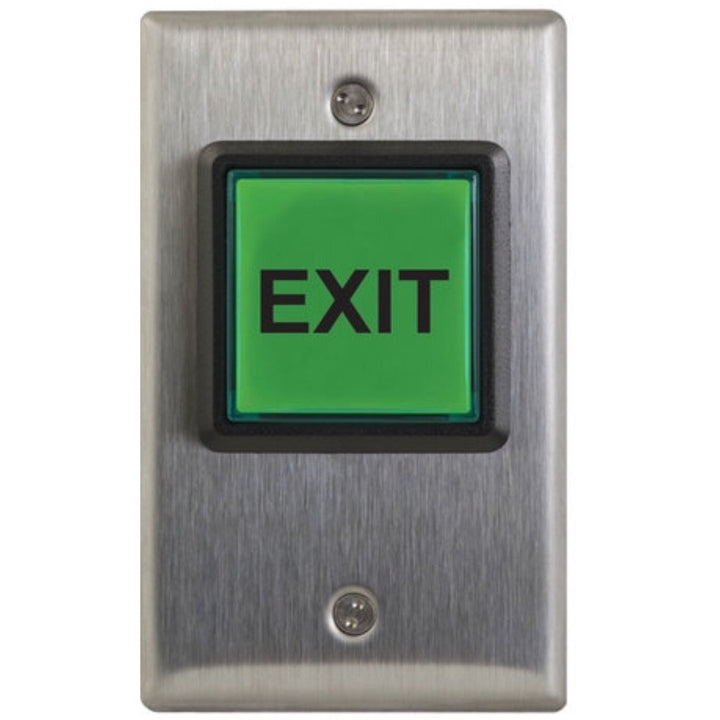
Camden CM-30E: A Request-to-Exit Button for a Mag Lock or Strike
Posted by Kent on 3rd Oct 2026
An electrified door with no way out is a liability, and a bare wall with a wire hanging out of it is not a finished install. The Camden CM-30E is the plain answer: a big, lit, single-gang pushbutton that tells the lock, the panel, or both that somebody is leaving. Here is what it does, what the specs allow, and what to check before you land the wires.
What the CM-30E is
The CM-30E is an LED illuminated request-to-exit (REX) pushbutton. It has a 2" square button on a single-gang stainless steel faceplate in satin stainless. The "E" model carries a single economical label reading "Push to Exit". Camden lists it as UL compliant, conforming to NFPA code requirements and ADA compliant.
The button is big on purpose. A person carrying boxes or pushing a cart finds a 2" target with an elbow. A small button on a plate does not get found in a hurry.
The electrical numbers
- Voltage: 12/24 VDC (for the LED)
- Contacts: SPDT Form C, rated 10 A at 30 VDC
- Switch type: momentary
- LED draw: 14 mA, with a Camden estimate of 10 years of life
Form C matters because it gives you both a normally-open and a normally-closed contact on the same switch. You pick the one your controller wants and leave the other alone. Momentary means the contact is only made while the button is pressed. That is what you want for a mag lock or a strike: press, release, door relocks on its own timer.
What it can control
Camden says these switches control electric locks, electromagnetic locks, electric strikes and low-energy door operators. They are also used for shunting, bypassing alarms, exit requests, and timed functions. That is a wide range for one part number.
Two common setups I see on real doors:
- Mag lock exit. The button interrupts power to the mag lock so the door releases. A mag lock with no other release is a code problem waiting to happen, so check your AHJ on what else the opening needs. Our Securitron holding-force guide covers sizing the lock side.
- Strike or panel input. The switch signals a controller that a valid exit is in progress, so the door does not alarm when it is opened from inside. That is the shunt use Camden calls out.
Wiring it without a callback
Do this in order, and test between each step:
- Decide what the switch is doing: cutting lock power directly, or signaling a panel input. They are different wiring jobs.
- Land the common and the contact your controller expects (NO or NC). Leave the spare alone and tape it off.
- Power the LED separately at 12 or 24 VDC. The LED is a light, not part of the switch circuit. Do not confuse the two.
- Press and hold. Then release. A momentary switch should only act while pressed. If the door stays released, the wrong contact or the wrong panel programming is the cause.
Contact rating is generous at 10 A, but do not push a large inductive load through it without a suppression device. A mag lock coil dumping current across a switch shortens contact life. That is standard practice and not specific to Camden. Check your lock manufacturer's notes for what they recommend.
Where to mount it
Put it on the secure side of the door, close enough that a person can see it from the door and reach it without crossing the swing. The ADA operable-parts reach range is generally 15" to 48" above the floor, and most installers land near the middle of that. Confirm the exact numbers with your inspector, since local amendments differ.
Keep it out of reach from the outside. If the door has glass or a sidelite, a button within arm's reach of the glass is an invitation. Someone reaches through a broken pane, or slips a tool through a gap, and presses it. On a glass-heavy entrance, mount the button on a solid wall on the far side of the door, or use a different exit method. This is the failure I see most on storefronts that put a REX button right next to a sidelite.
Testing before you leave
Run four checks before you close the ticket. Press the button and confirm the lock releases. Let go and confirm it relocks when the timer runs out. Pull the button's wire off the terminal and confirm the door fails the way the customer expects. Then check the LED is lit and dim enough to read at night. A door that only works when you are standing there is not finished.
Choosing it over a keyswitch or a sensor
A pushbutton is the right answer when everyone who uses the door is allowed to leave, which is nearly every interior and back-of-house exit. A keyswitch limits who can trigger it. Our keyswitch wiring guide covers that side. A motion sensor removes the button entirely, but sensors can be tripped by things other than a person leaving.
The button has the advantage in plain sight. Someone new to the building sees a lit pushbutton labeled Push to Exit and knows what to do. Our push button category lists other styles if a different faceplate or label suits the opening.
Buying it
Before you order, confirm the wall box: a single-gang plate needs a single-gang box, and the button plate is stainless. The switch is not a stand-in for a proper door release plan. It goes with a lock, a power supply, and a panel or timer that sits behind it. The rest of the Camden line, including the CX-ED1420 low-profile strike for tight jambs, is on our Camden page.
Common questions
Is the CM-30E a momentary or maintained switch?
Momentary. The contact is made only while the button is pressed, which is what a mag lock or strike release needs.
What contacts does it have?
SPDT Form C, rated 10 A at 30 VDC. That gives you both normally-open and normally-closed connections on one switch. Use the one your controller expects.
What voltage does the LED need?
12 or 24 VDC. The LED draws 14 mA, and Camden estimates 10 years of life.
Can it release a mag lock?
Camden lists electromagnetic locks among the devices these switches control. Check what else your local code requires on that opening, since a mag lock with only a button may not be enough.
Does the label say something other than Push to Exit?
The E model carries a single economical "Push to Exit" label. That is the version we list.