
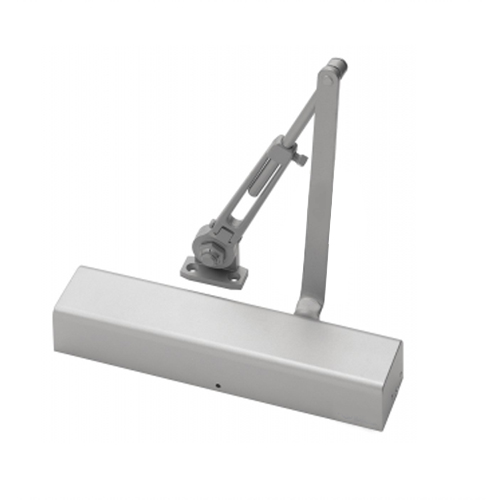
Norton 210: Tri-Packed or Heavy-Duty Arm, Hold-Open or Not
Posted by Kent on 5th Oct 2026
Four part numbers, one closer body
The Norton 210 is the closer I reach for when a customer needs something honest and sturdy for an office door, a utility door or a strip mall storefront, and does not need a spec-sheet monster. The catalog lists it as ANSI/BHMA A156.4 Grade 1, with a cast aluminum body, rack and pinion design and a full plastic cover. It is non-handed, so one closer works on a left-hand or right-hand door.
The confusion starts when you see the four versions on the shelf. They share the same body and differ in two things: which arm comes in the box, and whether that arm holds the door open.
- 210-TPH-689: hold open, tri-packed.
- 210-TPN-689: non-hold-open, tri-packed.
- 210-HDH-689: heavy-duty hold-open thumbturn arm with removable stop.
- 210-HDN-689: heavy-duty non-hold-open arm with removable stop.
All four are in the 689 aluminum finish. The letters are simple once you see the pattern: the last letter is H for hold open or N for non-hold-open. The two letters before it name the arm package.
What tri-packed means on this closer
The catalog describes the TP versions as tri-packed, with regular, parallel and top jamb mounting all covered. In plain terms, the box carries what you need to hang the closer three different ways, so you decide at the door instead of at the counter. A contractor who is pricing a dozen storefront doors and has not walked all of them yet will like that. A door with a deep reveal wants a different mounting than a flush one, and you find that out on site.
If you are not sure what those three mounting styles are, our write-up of the Norton 8000 series arm options walks through regular arm, parallel arm and top jamb, with the trade-offs on each. The geometry is the same whatever closer is attached to it.
The heavy-duty arm versions
The HD versions swap the tri-packed hardware for a heavy-duty arm with a removable stop. The catalog does not say how much heavier the arm is or what the stop is rated for, and I will not guess at a number. What the name tells you is useful on its own: the arm carries a stop, and you can take that stop off when the door has a wall or floor stop of its own and you do not want two things fighting over the swing.
The HDH adds a hold-open thumbturn on the arm. Turn it and the door stays where you put it. The HDN has no hold-open at all. It is the one for a door that must always return.
Hold-open or non-hold-open: decide by the door
Here is how I sort it out with a customer on the phone.
- Shop, utility room or back-of-house door that gets propped for deliveries. Hold-open. The door was going to get propped with a bucket anyway, so give them a proper way to do it.
- Office entry or any door a security plan depends on. Non-hold-open. Nobody should be able to leave it parked open.
- Any door with a fire label on the edge. Do not install hold-open on it without asking your inspector first. A rated door has to close and latch every time. Use a non-hold-open closer, or an approved electric hold-open that releases on the alarm.
That last point is the one I have seen go wrong. A tenant ropes a hold-open closer onto a labeled stair door because it is convenient, and the next inspection flags it.
Sizing and fit
The 210 has an adjustable spring, size 1 through 6, so the same closer covers a light interior door and a heavier exterior one. Spring power is the first adjustment, then the three independent valves. The catalog lists separate latch, sweep and backcheck intensity valves. Latch is the last few inches, where the door has to seat the latch bolt. Sweep is the main swing. Backcheck cushions the door if someone throws it open into a wall. Three valves means three small problems stay three small problems, and you do not chase one by breaking another.
For the install, the catalog gives these figures:
- Closer footprint: 3/4 in. x 12 in.
- Cover dimensions: 2-15/16 in. high x 2-1/8 in. deep x 13-1/16 in. long
- Sex nuts (SN-134) included.
Measure the space on the door where the cover has to sit, especially on a narrow aluminum stile or a door with a push plate near the top. A 13 in. cover is a real chunk of the head of the door.
When the 210 is the wrong closer
The catalog puts it at office, utility and strip mall work. It is not an institutional closer for a heavy door that gets slammed all day, and it is not an ADA power operator. For a door that takes real abuse, look at the Norton 7500 institutional closer. For a light commercial door that needs more mounting flexibility and a long track record, the Norton 1600 adjustable closer is the other one to compare.
Common questions
What does the H and N mean on a Norton 210 part number?
H means hold open and N means non-hold-open. The two letters before it, TP or HD, name the arm package.
Is the Norton 210 a Grade 1 closer?
Yes. The catalog lists the series as certified to ANSI/BHMA A156.4, Grade 1.
Can the Norton 210 go on a left-hand or right-hand door?
Yes. It is listed as non-handed.
Which spring sizes does the Norton 210 cover?
Adjustable spring size 1 through 6, with separate latch, sweep and backcheck intensity valves.
Can I use a hold-open Norton 210 on a fire door?
Check with your inspector first. A fire-rated door has to self-close and latch, so a hold-open closer on a labeled door is a code problem unless it is an approved release type.
The rest of the line is on our Norton door closer page. Tell us the door, the mounting space and whether it needs to hold open, and we will pick the right 210 for you.