
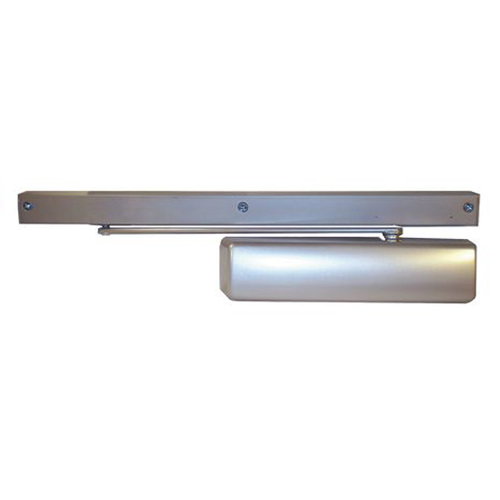
Norton 2800ST: Cam-Action Closer for a Slide Track Arm
Posted by Kent on 5th Oct 2026
Why a track arm needs a different kind of closer
A slide track arm sits flat against the door and rides in a channel, so the closer never reaches out into the opening the way a regular arm does. Hospitals and universities love them for exactly that reason: the arm stays tucked, a cane or a wheelchair footrest has less to catch, and the door looks clean. The catch is that the closer has to push through a sliding joint, and a plain rack and pinion closer loses a lot of its leverage doing it.
That is the problem the Norton 2800ST was built for. The catalog describes it as a cam action closer for slide arm and track arm applications, and says it is more efficient than a rack and pinion closer on a slide track. The practical result is a door that opens easier and still closes with authority.
What cam action changes at the door
A rack and pinion closer, like the one in the Norton 1600, delivers a fairly even force through the swing. That works with a regular or parallel arm. Put a track arm on that same closer and the geometry changes: the push of the arm along the track is at a shallow angle for much of the swing, and you feel it as a heavy door to open.
The cam shape in the 2800ST is built to fix that. The catalog says the cam action gives much lower opening resistance while delivering optimum closing force and control. The catalog says it plainly: it is easier to open than a rack and pinion closer with a track arm. For a door that sees patients, students or elderly visitors, that is the whole point.
The two listings
- 2800ST-689: aluminum finish.
- 2800ST-690: statuary bronze finish.
Both are the same closer. Both are non-hold-open and non-handed, with a cast aluminum body and an adjustable spring, size 1 through 6. The catalog lists the slide track as standard, so the arm comes with it. Pick the finish by what the rest of the door hardware looks like. Match the closer to the lever or the pull, not to the frame.
Pull side, push side
The 2800ST is listed as a pull side closer, and the catalog also says it can be installed push or pull side. Pull side means the closer is mounted on the side of the door you pull to open it, which is the usual layout for a track arm on an inside corridor door. Push side mounting is the other layout. If you are not sure which side your door puts the closer on, tell us which way the door swings and which side has the frame stop, and we will sort it out.
The limits you need to respect
Here are the sizing limits the catalog gives, and they are firm:
- Recommended maximum door weight: 250 lbs.
- Recommended maximum interior door width: 54 in. (137 cm).
The width limit is stated for an interior door. The catalog does not give an exterior width number, and I will not guess at one. It does say the closer is suitable for exterior and interior doors, so for an exterior door at the edge of that width, send us the opening size and we will check before you order.
A typical wood or hollow metal corridor door is well under that, but a heavy solid core door with a glass lite can get close. Weigh it or ask the door maker before you assume.
Spring size, one step at a time
With sizes 1 through 6, the spring is the first thing to tune. Start in the middle of the range for a typical interior door, close the door, and watch the last few inches. If it will not latch, add spring. If it is hard to open, back it off, and remember that on a cam closer the opening effort is already lower than on a rack and pinion at the same size. Do not use the spring to make up for a door that is dragging on its hinges or a latch that is binding. Fix the door first.
Where this closer belongs
The catalog names hospitals, universities and office buildings as the typical homes for the 2800ST. That matches what I see in the field: long corridors with doors that people open dozens of times an hour, many of them with something in their hands or a walker in front of them. A closer that takes less effort to open wins the argument at every one of those doors, because the complaint call comes from the person who cannot push the door, not from the person who installed it.
It is less of a fit on a small door where nobody has asked for a track arm. A regular arm closer costs less to hang and has fewer parts to check on a maintenance round. Use the 2800ST when the track arm is the design decision, not as a default.
When another closer is the better call
If the door is going to get abused all day and a regular arm will do, the Norton 7500 institutional closer is built for that kind of treatment. If the door needs a low-energy power operator for accessible entry, read our guide to the Norton 5700 series operators. The 2800ST earns its place where a track arm is the right arm.
Common questions
What is a cam action door closer?
A closer that uses a cam instead of a plain rack and pinion. The catalog says the 2800ST gives lower opening resistance while keeping strong closing force, especially with a slide track arm.
What is the maximum door weight for a Norton 2800ST?
The catalog gives a recommended maximum of 250 lbs.
How wide a door can a Norton 2800ST handle?
The recommended maximum interior door width is 54 in. (137 cm). The catalog gives no separate exterior width.
Does the Norton 2800ST hold the door open?
No. It is a non-hold-open closer.
Is the slide track included?
The catalog lists the slide track as standard on this closer.
See the whole line on our Norton door closer page. Send us the door weight, width and swing and we will confirm the 2800ST fits.