
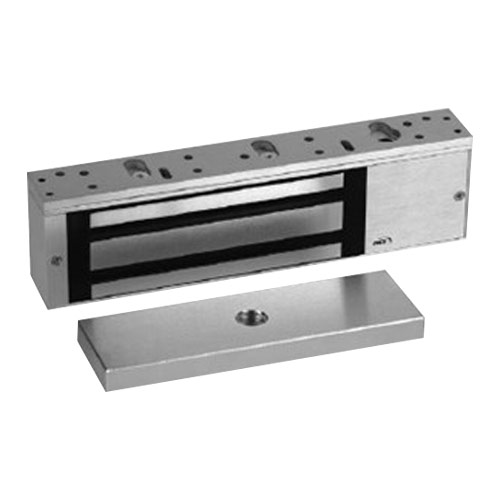
RCI 8310 Maglock: Base, DSS, SCS or Both Sensors
Posted by Kent on 16th Oct 2026
One magnet, four versions, and the difference is what it tells you
The RCI 8310 is a single outswinging maglock. Every version holds the door with the same magnet: one-point locking up to 1500 pounds, field selectable 12 or 24V DC, a built-in adjustable time delay, plug-in wiring terminals and MOV surge protection. The magnet does not change from one part number to the next.
What changes is the sensing. The base lock is a magnet and nothing else. The DSS adds a door status sensor. The SCS adds a security condition sensor. The DSS-SCS carries both. The price climbs with each, and that is where people either overbuy or underbuy.
Both mistakes are common. The base lock goes on a door someone was supposed to monitor, and a second device gets bolted on later where there is no room for it. Or the full package goes on a supply closet nobody watches. Here is how I would sort it.
The base 8310: 8310-28 in aluminum
The base lock is the plain version. It is the least expensive of the four, in brushed anodized aluminum. It has the adjustable time delay, which the listing describes as instant release with adjustable relock, programmable from 0 to 110 seconds. It has low energy draw and no residual magnetism, which matters because a magnet that stays magnetized after power drops will hold a door that should be free.
Use it where the lock is the whole job. A storeroom with a keypad outside and a push button inside. A back door that only needs to hold while the building is armed. If nobody needs to see whether the door is open or closed, you do not need a sensor.
It also comes in dark bronze as the 8310-40 in dark bronze. Finish is the only difference, and the dark bronze costs a little more than aluminum.
The DSS: 8310-DSS-28 reports whether the door is open
The DSS is the middle step, and the one most panels ask for. The listing calls it a ceramic magnet-reed type sensor for remote indication of door status, and the reed switch sits inside the electronic housing cavity where you can get at it. It costs more than the base lock, and less than the SCS.
It answers a single question: is the door closed? That is the signal a control panel wants before it arms a zone, and the one a security desk wants when a door has been propped. A magnetic lock with no status sensor cannot tell you that. It can only tell you power is applied.
It is the right pick when the maglock is tied into an alarm or access panel that asks for a door contact. If you already have a separate door contact on the frame, you do not need to pay for another one.
The wiring is part of the cost. The sensor gives you one more pair of wires back to the panel, and on a long run through a finished ceiling, that is labor. Count the conductors before you decide. If the cable you already pulled has no spare pair, you are out of room.
The SCS: 8310-SCS-28 reports whether the lock is really holding
The SCS is the one most people misread. A security condition sensor does not tell you whether the door is open. It tells you the state of the lock itself.
The listing calls it an electronic field presence sensor for remote and local LED indication of lock status. It also lists detection of reduced holding force caused by material between the magnet and the plate, and of an unlocked device due to current loss. It adds low voltage detection, an LED and a form C relay. It costs more than the DSS.
Why does that matter? A magnet only holds at full force when its face and the armature plate sit flat against each other. Paint, a layer of tape, a misaligned plate or a bent door can leave a gap and cut the holding force without anyone noticing. A door that looks locked and pulls open with a firm yank is a real failure. The SCS exists to catch that.
Put it on the door where the lock is the protection. A pharmacy back door. A cash room. A computer room that lives behind a single outswinging leaf. Those are the doors where I would want to know that the magnet is not just powered, it is holding.
The DSS-SCS: 8310-DSS-SCS-28 does both
The full package lists a door status sensor and a security condition sensor. It is the most expensive of the four, because you are paying for both sensors.
The listing for this version reads shorter than the others. It says it includes both sensors and carries the low voltage detection line that the SCS carries. It does not spell out the form C relay and LED lines separately for this part number, so if the relay output matters to your panel, ask us to confirm it before you order.
I specify this one on any door that is a controlled perimeter and has a panel that logs events. You get the open or closed signal and the lock-holding signal, and you do not discover six months later that you needed the second one.
Side by side
| Part | Sensor | Answers | Cost step |
|---|---|---|---|
| 8310-28 | None | Nothing, it holds the door | Lowest |
| 8310-DSS-28 | Door status (reed switch) | Is the door closed? | Above base |
| 8310-SCS-28 | Security condition | Is the lock actually holding? | Above DSS |
| 8310-DSS-SCS-28 | Both | Both questions | Highest |
What does not change
All four are single outswinging locks. If you have a pair of doors, that is a different housing, and we cover it in the RCI 8320 article. If the opening is too small for a full size lock, the 8371 MiniMag is the smaller unit.
The holding force is 1500 pounds on all of them. Do not pay for a sensor and expect more hold. The sensor does not add force.
Power is the same too. The 12 or 24V selection is made in the field, and the supply has to match. We go through holding force and matching in the Securitron holding force article, and the same logic applies to any maglock.
Mistakes I see
Buying the SCS to get a door contact. It does not give you an open or closed signal. If you want that, buy the DSS or the combination.
Buying the DSS and assuming it proves the door is locked. A closed door and a holding lock are two different facts.
Skipping the plate alignment. The armature plate has to sit flat on the magnet. A sensor that reports reduced holding force will tell you, loudly, that it does not.
Forgetting that a maglock fails safe. When power goes, the door is free. That is the correct behavior for life safety and the wrong one for a door that must stay locked in an outage. Check the code before you choose a maglock for a perimeter door.
Common questions
Can I add a sensor to a base lock later?
The listings sell the sensors as complete part numbers. I do not have an add-on kit listed, so plan on buying the version you need.
Does the time delay cost extra?
No. All four list the built-in adjustable time delay, 0 to 110 seconds.
Which finish do I pick?
The listings show brushed anodized aluminum, code 28, and dark bronze, code 40. Match it to your hardware.
Is it UL listed?
The listing says the 8310 series is certified UL listed. Confirm the exact standard on the part you pick if your inspector asks.
Browse the full line on our RCI page. Send us the door and the panel and we will tell you which sensor you actually need.