
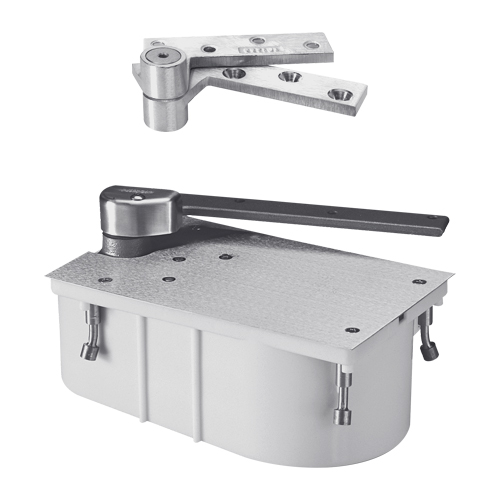
Rixson 27-85N, 90N, 95N, 105N, 85S: Dead Stop Angle
Posted by Kent on 19th Oct 2026
The number in a Rixson 27 part number is the dead stop
A buyer asks for "a Rixson 27 floor closer" and we have to ask the next question, because there are dozens of them. On this family the first number after the 27 is the angle at which the door hits a built-in stop. The 27-85N stops the door at 85 degrees. The 27-90N stops it at 90, the 27-95N at 95 and the 27-105N at 105. Pick the wrong one and you either bang the door into something you did not plan for, or you lose clear width you needed.
All of them are the same closer otherwise. Same 3/4 in. offset hung pivot, same heavy-duty case, same weight and width limits. So this is a short decision. What is behind the door when it opens, and does the door need to hold open or not?
What the listings say, side by side
| Part | Dead stop | Hold open | Mounting | Fire rating |
|---|---|---|---|---|
| 27-85N-LH-606 | 85 degrees | Non hold-open | 3/4 in. offset, single acting | Non fire rated |
| 27-90N-LH-626 | 90 degrees | Non hold-open | 3/4 in. offset, single acting | Non fire rated |
| 27-95N-LH-626 | 95 degrees | Non hold-open | 3/4 in. offset, single acting | Non fire rated |
| 27-105N-LH-626 | 105 degrees | Non hold-open | 3/4 in. offset, single acting | Non fire rated |
| 27-85S-LH-626 | 85 degrees | Selective hold open | 3/4 in. offset, single acting | Non fire rated |
Every one is listed to 450 lbs door weight and a door width up to 4 ft 0 in., with a cement case the listing calls rust-proof, a standard 180 top pivot included, and certification to ANSI/BHMA A156.4. The rows above show left hand parts. Each number is also listed right hand and in several finishes, so the finish in the table is only the one we picked for the example.
Choosing the angle: look at what the door hits
A floor closer with a dead stop does not rely on a wall stop or a floor stop to catch the door. The closer itself refuses to go past its angle. That protects the glass, the frame and the closer arm from a door that someone swings hard. It also means the angle is a permanent decision. You cannot open the door further than the stop allows.
85 or 90 degrees
This is where most interior and storefront doors land. A door that opens to 90 sits square to the wall, and a door that stops at 85 stays a little shy of it. If there is a wall, a coat rail, a cabinet or a radiator right behind the open door, the smaller angle keeps it off that surface. If the door opens onto a corridor with a handrail, 85 gives you a few degrees of gap that people forget to account for.
95 degrees
A step wider. Choose this when 90 pinches the clear opening just enough to hurt. A door that is already near the 4 ft width limit is a typical case, or a doorway that carts, gurneys or wide deliveries use. The listing gives no clear width figure for the angle, so measure the opening with the door at the stop before you commit.
105 degrees
The widest of the group. A 105 degree door swings past square, which gives you the most clear opening. It also puts the door leaf further toward whatever is on the hinge side wall. Check that wall. A door that has room to swing past 90 is fine. One that is two feet from a perpendicular wall is not.
Selective hold open: the S in 27-85S
The N parts do not hold the door open. The S part does, selectively, and it is the only 85 degree part on this list that does. Selective means you choose it. The door can be held open when you want it open, and it closes normally when you do not. That is the useful setup for a door that has long open periods. Think of a delivery door in the morning, or a shop door in nice weather.
Do not hold a fire-labelled door open with one of these. The five parts above are listed non fire rated, and a fire door has to close and latch every time. The F27 version is the rated closer, and we cover the difference in the 27 versus F27 article.
What does not change from one angle to the next
The weight limit does not go up with the angle. A 105 degree stop is not a heavier-duty closer, it is the same closer with a longer swing before the stop. If the door is heavier than 450 lbs, or wider than 4 ft, none of these will do, and you are looking at a different Rixson number entirely.
The listing also notes that door size and weight guidelines assume the right number of intermediate pivots. A tall or heavy door wants more than the top and bottom pivots. The part numbers here include the standard top pivot only, so plan your intermediates separately.
If you already have a 27 on the door
Read the number off the old closer before you order. If it says 27-90N, replace it with a 27-90N, not a 27-95N, unless you have a reason to change the swing. Handing matters too. The pivot is handed, and the part you order has to match the way the door swings. The listing does not walk through how to determine handing, and a wrong-hand floor closer is a bad day, so send us a photo and the door's swing direction and we will confirm.
For the hold-open question on the larger 180 degree parts, see the 180N versus 180A comparison. If the closer is going on an exterior door in a cold climate, the cold weather fluid article is the one to read first. The wider overview is in our Rixson 27 buyer guide.
Common questions
What does the 85 in 27-85N mean?
The dead stop angle. A built-in positive stop keeps the door from swinging past 85 degrees.
What is the difference between the N and the S?
N is non hold-open. S is selective hold open. The listings show the 27-85S as the hold open version at 85 degrees.
Is any of these fire rated?
No. All five listings say non fire rated. The F27 series is the fire rated closer in this family.
How heavy a door will they handle?
Up to 450 lbs and a door width up to 4 ft 0 in., with the intermediate pivots the door needs.
Does the angle change the closer?
The listings show the same mounting, case and ratings. The difference is where the dead stop sits.
The full line of floor closers is on our Rixson page. Tell us what is behind the door and we will match the angle.