
Securitron M38 Maglock: What D, L, S and T Add
Posted by Kent on 25th Nov 2026
Seven M38 part numbers, one lock
Pull up the Securitron M38 and you get seven listings: M38, M38D, M38DL, M38DLS, M38DLST, M38DS and M38LS. A customer who has to pick one usually asks which is "the good one." None is better. They are the same 600 lb magnet in the same housing. What changes is the list of sensors built in. Pick the sensors your controller will actually read and buy that number.
One thing to know up front. The body text on every M38 listing is word for word the same. The model name in the title is the only thing that tells the versions apart. I will use the titles, since that is what the catalog gives us.
What every M38 has in common
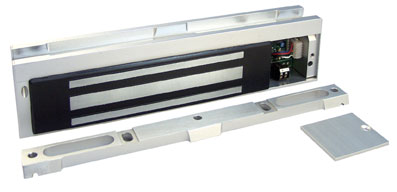
The listing describes the M38 as a 600 lb holding force Magnalock with automatic dual voltage, a built-in wire access chamber, and a bracket mount design. The finish is brushed aluminum. Automatic dual voltage means no field adjustment between a 12 volt and a 24 volt supply. The listing also names an instant release circuit with no residual magnetism, plated ferrous surfaces to resist rust, and the Securitron MagnaCare lifetime replacement warranty.
The same listing says where it belongs: areas where physical assault on the door is not expected, such as secured areas that are being watched or an interior room you need locked against honest prying eyes. That is a straight statement. A 600 lb magnet is a strong deterrent against a casual shove and no match for a determined kick on a door with a weak frame. If the door faces the outside or the parking lot, step up. Our guide to matching maglock holding force to the real threat walks through that choice.
Decoding the letters from the titles
The titles spell out what each letter adds. Here is the catalog list, model by model.
- M38: the lock alone, no sensors.
- M38D: adds a door position switch.
- M38DL: door position switch plus an LED indicator.
- M38DS: door position switch plus Senstat.
- M38LS: LED indicator plus Senstat, no door position switch.
- M38DLS: door position switch, LED indicator and Senstat.
- M38DLST: all of those plus an anti-tamper switch.
So D is door position, L is LED, S is Senstat and T is tamper. That is as far as the listings go. They name the Senstat feature but do not explain how it works, and they do not say what color the LED is, what the contact rating is on the door position switch, or what the tamper switch trips on. I will not guess. If your panel needs a specific contact type or signal level, call before you order the S or T versions.
Which version for which job
The bare M38 is the right buy when the door only needs to be held shut and nothing else needs to know. A storeroom, a records closet, a back office. The controller gives it power, drops power to release it, and that is the whole system.
M38D is the one I would pick for most doors getting access control. The door position switch lets the panel know the door is closed. Without it, the system cannot tell a door that was opened and left ajar from a door that is shut. That matters for door-held-open alarms and for knowing when it is safe to relock. If you already run a separate Securitron door position switch, you can save the money and buy the plain M38, but the built-in one is one less thing to mount and one less thing to align.
M38DL adds the LED. The point of an LED on a maglock is to give someone standing at the door a visible sign of the lock's state. That is useful when a technician is trying to figure out why a door will not open and wants a quick look before reaching for a meter.
M38DLS, M38DS and M38LS bring in Senstat. Ask for a spec sheet from the manufacturer before committing, since the catalog listing does not describe it. Of the three, only the M38LS leaves out the door position switch, which is an odd mix. If your panel needs door position, do not order the LS.
M38DLST is the full set. It makes sense where someone might try to get at the lock itself and the system should say so. Interior doors in a lab, a pharmacy back room or an equipment cage are the typical fit.
What you still have to buy
The M38 does not come with everything. The listing mentions a bracket mount design and a wire access chamber. It does not list an armature plate, a power supply or an exit device. Plan for the following.
- A power supply. Maglocks draw steady current whenever the door is locked. Our power supply comparison covers what to match to the lock.
- A way out. The magnet releases when power is cut, and the egress path has to be handled in the controls. The emergency exit button guide shows the standard approach. If the door needs delayed egress, see our delayed egress timer article, and check with your local inspector before you plan on it.
- A header you can mount to. A maglock bolts to the header and the plate bolts to the door. A narrow header, a rolled stop or a glass door each need a bracket. The listing says the lock mounts with common tools, so plan the header work early.
M38 or something else
The M32 family sits in the same 600 lb class and uses a similar letter system, and it has its own guide. The M38 is the one to look at when you want the wire access chamber or the Senstat options. If the door needs more than 600 lb, the M62 is the next stop.
What the listings do not say
I have no current draw, no dimensions, no weight, no UL or fire rating on the M38 pages, and no statement about indoor versus outdoor use beyond the interior recommendation. The listings do not cover armature plate hardware or bracket compatibility. Everything above comes from the listings. For anything else, ask.
Send us the door type, the frame material, the header width, what your controller reads, and whether the door needs to be locked or unlocked on power loss. We will tell you which M38 number fits, or tell you it is the wrong lock.