
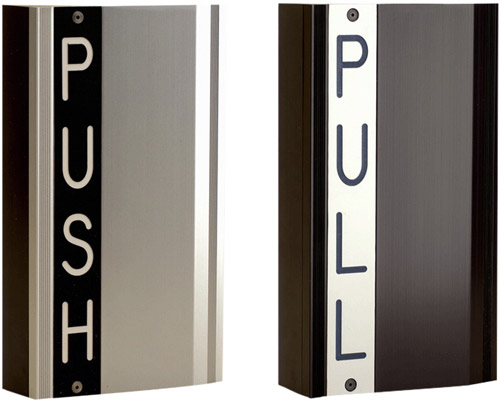
Securitron TSH or EMH Handle: Maglock Release In the Pull
Posted by Kent on 26th Nov 2026
A handle that releases the maglock
The door has a maglock. Somebody needs to walk out of it without hunting for a button. The Securitron touch sense handle and the electromechanical handle both solve that by putting the release in the pull itself. A person reaches for the door the way they always would, the lock lets go, and nobody needs a sign that says push to exit.
Securitron makes two kinds, and the difference matters more than the finish. The TSH has no moving parts. The EMH has a handle that moves. One is for indoors, the other is listed for outdoors. Get that wrong and you will be back on the door in a year.
TSH: touch, no movement
The TSH-BK and TSH-CL are the Touch Sense Handle, in black anodized and clear anodized. The listings describe a handle sized to cover existing mounting holes and used for standard pulls on aluminum doors. It can work as an opening pull on swinging doors, or as an alternate push-open device on doors that swing either way. The look is the point: the listing says it gives a different look on aluminum frame glass doors.
What it does: it instantly activates a DPST 2 amp rated relay when touched, with no mechanical movement, to allow free egress. A backup push button is included. The listing says it operates on 12 or 24 volts DC and comes with 16 feet of 22 AWG, 6 conductor cable and an armored door cord. The size is 5 inches long, 2-1/8 inches deep and 9 inches high. The listing says UL listed hardware and, importantly, indoor use only.
Because it is a touch sensor, the TSH needs power and a relay output tied into the maglock circuit. That is a controller job. If you have never wired a maglock release through a touch sensor, our touch bar and push bar comparison goes through the same logic for the bar versions.
EMH: a handle that moves
The EMH-BK and EMH-CL are the Electromechanical Handle. The listing says it is designed for any push, pull or swing-through door and is equipped with an internal initiate that allows mechanical handle movement for specialized outdoor applications. It adds that the EMH meets the "no special tools or knowledge" criteria for code requirements. That phrase is the whole point of a mechanical handle at an exit. Anyone can operate it without being told how.
What it does: it instantly activates a DPDT 2 amp rated output when pushed or pulled, either allowing free egress or starting the delay on an exit delay timer. The listing includes 16 feet of 22 AWG, 3 conductor cable and an armored door cord, and states the same dimensions as the TSH: 5 inches long, 2-1/8 inches deep and 9 inches high. It is listed as UL listed hardware for outdoor applications.
So here is the cleanest way to split them. Indoors, with a person who wants a neat glass door and no moving parts, the TSH. Outdoors, or anywhere a touch sensor would have trouble with weather or glove-wearing hands, the EMH. The listings draw that line themselves.
The EL versions
You will also see EL-TSH-BK, EL-TSH-CL and EL-EMH-CL. The listings add one line to the feature list: "ElectroLynx Ready unit." The listings do not explain what ElectroLynx is or what it connects to, so I will not either. If the job already specifies ElectroLynx, buy the EL version. If it does not, the plain TSH and EMH are the ones to quote.
The catalog carries one clear EL-EMH and no black one at this time. If you need a black EMH with ElectroLynx, tell us and we will check what is available.
Where it goes in the system
Neither handle is a lock. It is a release. Both are meant to be wired to a maglock or a similar fail-safe lock, as the listing language about maglock release and exit delay timers makes clear. The release signal goes to the controller or the lock's power circuit. The lock is the Securitron M62, M32 or M34R, or whatever you picked for the opening.
The EMH listing mentions starting the delay on an exit delay timer. If the building needs delayed egress, the handle is the initiating device and the XDT timer is the brain. Delayed egress is regulated by code and by your local inspector. The listing's code language is about handle operation, not about whether a given delay is allowed in your building. Check before you design around it.
If the handle is not what you need, there are other release options on the same family. A touch plate or keyswitch goes on the wall, and the emergency exit button is the plainest option.
Picking one
- Aluminum glass door, inside the building, clean look. TSH in black or clear to match the frame.
- Door that faces outside, or a place where weather is a factor. EMH, per the outdoor listing. Get the finish that matches your storefront.
- A job already wired with ElectroLynx. The EL version of whichever you chose.
- Door where the code inspector asks how a person would know how to exit. The EMH listing is the one that speaks to code language. Show the inspector the listing.
What the listings do not say
I have no weight and no statement of how the touch sensor is protected from false triggers. I do not know the pull force the EMH needs, whether the handle is a replacement for an existing pull on a given storefront door, or what the mounting hole spacing is. The TSH listing says it covers existing mounting holes but does not give the pattern. Send us the door and what the old pull looks like, and we will tell you whether it is a fit before you order.